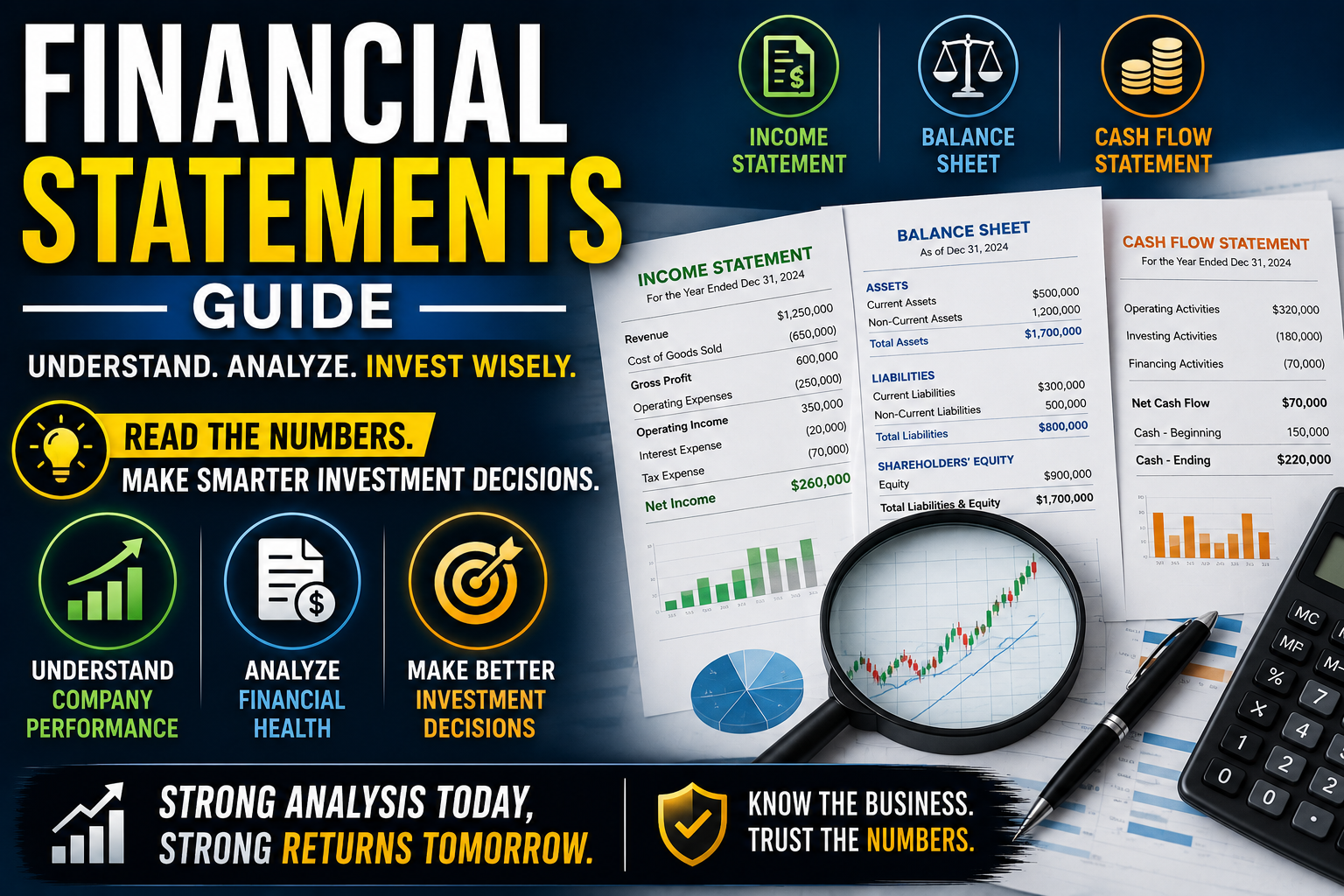
Learn everything about Financial Statements, including the balance sheet, income statement, and cash flow statement. Discover how investors use financial statements to evaluate a company’s financial health before investing.
Table of Contents
Every successful investor shares one common habit—they don’t invest based on hype, headlines, or social media recommendations. Instead, they analyze a company’s financial statements before making any investment decision.
Think of financial statements as a company’s report card. Just as a doctor examines your health through medical reports, investors examine a company’s financial health through its financial statements. These reports reveal how much money a business earns, how much it spends, what it owns, what it owes, and how effectively it manages cash.
Whether you’re investing in stocks, evaluating a business, or simply trying to understand how companies operate, learning to read financial statements is one of the most valuable financial skills you can develop.
In this guide, we’ll explain the three primary financial statements, how they work together, the most important financial metrics to watch, common mistakes beginners make, and how professional investors use them to make informed investment decisions.
What Are Financial Statements?
Financial statements are formal reports that summarize a company’s financial performance and financial position over a specific period. They provide investors, lenders, regulators, analysts, and management with standardized information about the company’s operations.
Publicly traded companies are required to publish financial statements regularly so investors can evaluate their financial condition.
The three primary financial statements are:
- Income Statement
- Balance Sheet
- Cash Flow Statement
Together, these reports provide a complete picture of a company’s financial health.
To understand financial reporting standards, visit the International Financial Reporting Standards (IFRS) Foundation:
Why Financial Statements Matter
Financial statements help answer important questions such as:
- Is the company making a profit?
- Is revenue growing consistently?
- Can the company repay its debts?
- Does it generate enough cash?
- Is management using assets efficiently?
- Is the business financially stable?
Without analyzing financial statements, investing becomes speculation rather than informed decision-making.
Professional investors, hedge funds, banks, and institutional asset managers all begin their analysis with these reports.
The Three Main Financial Statements
Although each statement provides different information, they work together to explain a company’s overall financial performance.
Let’s examine each one individually.
1. Income Statement
The Income Statement, also known as the Profit and Loss (P&L) Statement, shows how much revenue a company earned and how much it spent during a specific accounting period.
Its primary purpose is to determine whether the business generated a profit or incurred a loss.
A simplified Income Statement looks like this:
Revenue
− Cost of Goods Sold
= Gross Profit
− Operating Expenses
= Operating Income
− Interest & Taxes
= Net Income
Revenue represents the money earned from selling products or services.
Expenses include manufacturing costs, employee salaries, marketing expenses, rent, utilities, depreciation, and taxes.
Net Income—often called the “bottom line”—represents the company’s final profit after deducting all expenses.
Investors closely examine trends in revenue growth and profit margins because consistently increasing profits often indicate a healthy business.
Learn more about corporate financial reporting through the U.S. Securities and Exchange Commission (SEC):
Understanding Revenue
Revenue is often called the “top line” because it appears at the top of the income statement.
For example, if a software company sells subscriptions worth $5 billion during a year, its annual revenue is $5 billion.
Growing revenue generally indicates increasing demand for a company’s products or services.
However, high revenue alone doesn’t guarantee profitability.
A company can generate billions in revenue while still losing money if expenses rise faster than sales.
Understanding Net Income
Net Income represents the company’s final earnings after deducting every expense.
Positive net income indicates profitability.
Negative net income indicates a net loss.
Companies with consistently growing net income are generally considered financially stronger than businesses experiencing declining profits.
2. Balance Sheet
While the Income Statement measures performance over a period, the Balance Sheet provides a snapshot of a company’s financial position at a specific point in time.
It answers one simple question:
“What does the company own, and what does it owe?”
The Balance Sheet follows one of the most important accounting equations:
Assets = Liabilities + Shareholders’ Equity
This equation always remains balanced.
Assets
Assets are resources owned by the company that provide future economic benefits.
Examples include:
- Cash
- Inventory
- Buildings
- Equipment
- Investments
- Intellectual Property
- Accounts Receivable
Assets are generally classified as Current Assets and Non-Current Assets.
Current Assets can typically be converted into cash within one year.
Liabilities
Liabilities represent obligations the company must repay.
Examples include:
- Bank loans
- Bonds
- Accounts payable
- Salaries payable
- Taxes payable
High debt isn’t always bad, but investors should examine whether the company can comfortably manage its obligations.
Shareholders’ Equity
Shareholders’ Equity represents the owners’ residual interest after liabilities are deducted from assets.
It includes:
- Paid-in Capital
- Retained Earnings
- Treasury Shares
- Other Comprehensive Income
A growing equity balance often reflects increasing business value over time.
3. Cash Flow Statement
Many beginners assume profitable companies always have strong cash flow.
That’s not necessarily true.
A company can report large accounting profits while running short of actual cash.
The Cash Flow Statement explains where cash comes from and where it goes.
It is divided into three sections.
Operating Activities
Operating Cash Flow measures cash generated from normal business operations.
Positive operating cash flow usually indicates a healthy business.
Investors often prefer companies generating consistent operating cash flow.
Investing Activities
This section records money spent on long-term investments.
Examples include:
- Buying factories
- Purchasing equipment
- Acquiring businesses
- Selling investments
Large cash outflows aren’t necessarily negative because they may support future growth.
Financing Activities
Financing Cash Flow includes:
- Issuing shares
- Paying dividends
- Borrowing money
- Repaying loans
- Share buybacks
This section helps investors understand how the company finances its operations.
How the Three Statements Work Together
These financial statements aren’t independent documents.
They’re closely connected.
For example:
A company earns revenue on the Income Statement.
Its profit increases retained earnings on the Balance Sheet.
If customers actually pay cash, that cash appears in the Cash Flow Statement.
Understanding these relationships gives investors a much clearer picture of business performance.
Financial Ratios Investors Should Know
Reading financial statements becomes even more useful when combined with financial ratios.
Price-to-Earnings (P/E) Ratio
Measures how much investors are willing to pay for each dollar of earnings.
Lower isn’t always better, but extremely high P/E ratios may indicate expensive valuations.
Debt-to-Equity Ratio
Shows how much debt the company uses relative to shareholder equity.
Very high debt levels may increase financial risk.
Current Ratio
Measures the company’s ability to meet short-term obligations.
Higher current ratios generally indicate stronger liquidity.
Return on Equity (ROE)
Measures how effectively management generates profits using shareholders’ equity.
Many long-term investors prefer companies with consistently high ROE.
Free Cash Flow
Free Cash Flow measures the cash remaining after necessary capital expenditures.
Strong free cash flow often supports:
- Dividend payments
- Share buybacks
- Business expansion
- Debt reduction
Red Flags to Watch
Financial statements don’t always tell a positive story.
Warning signs include:
- Declining revenue
- Falling profit margins
- Rising debt
- Negative operating cash flow
- Frequent share dilution
- Large one-time accounting adjustments
- Declining cash reserves
A single warning sign doesn’t necessarily indicate a poor investment, but multiple issues deserve closer investigation.
Common Mistakes Beginners Make
Many new investors make avoidable mistakes when reading financial statements.
Some of the most common include:
- Looking only at revenue while ignoring profitability.
- Focusing solely on net income without checking cash flow.
- Ignoring debt levels.
- Comparing companies from different industries.
- Making investment decisions based on one quarter instead of long-term trends.
- Ignoring notes to the financial statements.
Financial statements should always be analyzed over multiple years rather than a single reporting period.
Where Can Investors Find Financial Statements?
Public companies publish their financial reports through official regulatory filings and investor relations websites.
Reliable sources include:
- SEC EDGAR Database (United States)
https://www.sec.gov/edgar - Company Investor Relations Pages (available on most publicly listed companies’ official websites)
- Nasdaq Market Data
https://www.nasdaq.com
These sources provide audited financial reports that investors can rely on.
Frequently Asked Questions
What are the three main financial statements?
The three primary financial statements are the Income Statement, Balance Sheet, and Cash Flow Statement.
Which financial statement is most important?
All three are important because they provide different perspectives. Together, they present a complete picture of a company’s financial health.
Can a profitable company run out of cash?
Yes. Accounting profit and cash flow are different. A company may report profits while facing cash shortages if customers delay payments or large expenses require immediate cash.
Why do investors analyze financial statements?
Investors use financial statements to evaluate profitability, financial stability, liquidity, debt levels, operational efficiency, and long-term growth potential before making investment decisions.
Conclusion
Understanding Financial Statements is one of the most important skills every investor can develop. These reports provide a transparent view of a company’s financial health, helping investors distinguish between businesses with sustainable growth and those facing financial challenges.
The Income Statement explains how a company earns profits, the Balance Sheet reveals what it owns and owes, and the Cash Flow Statement shows how money moves through the business. Together, they offer a comprehensive picture that goes far beyond headlines or stock price movements.
Rather than relying on market speculation, investors who consistently analyze financial statements can make more informed decisions, better assess risk, and identify companies with strong long-term potential. Whether you’re evaluating a global technology company, a manufacturing business, or an emerging startup, understanding financial statements is an essential step toward becoming a more confident and disciplined investor.
Discover the most important economic indicators every investor should know. Learn how GDP, inflation, interest rates, unemployment, PMI, and other key indicators influence stock markets, bonds, and investment decisions.
