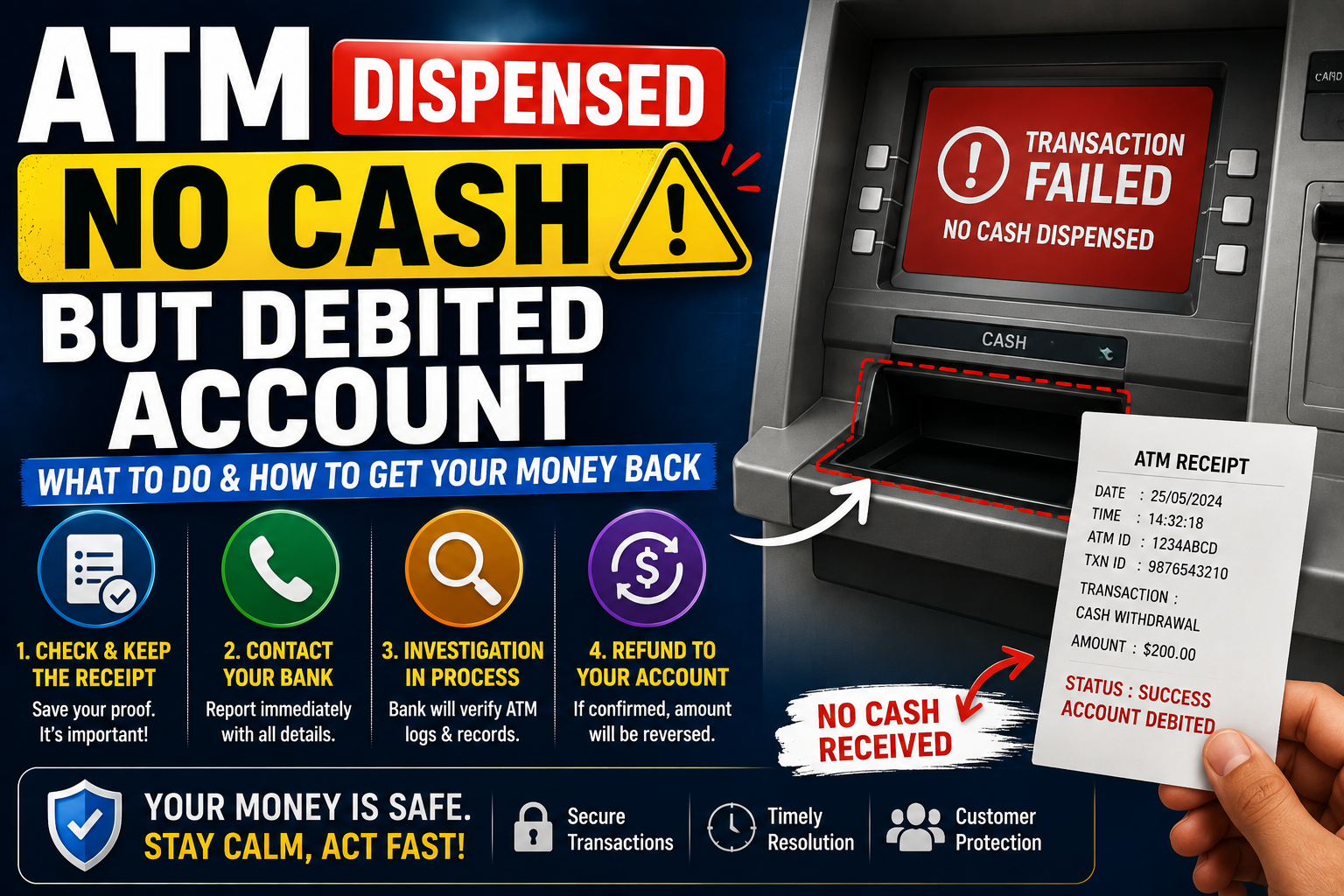
Learn what to do if an ATM dispensed no cash but debited your account. Discover why ATM cash withdrawal failures happen, how refunds work, common causes, and the steps to recover your money quickly.
Table of Contents
Using an Automated Teller Machine (ATM) is one of the most convenient ways to access cash. Millions of people rely on ATMs every day for withdrawals, balance inquiries, deposits, and other banking services. Most transactions are completed within seconds without any issues.
However, there are times when things don’t go as planned. One of the most frustrating situations occurs when an ATM dispensed no cash but debited your account. You request a withdrawal, the ATM processes the transaction, your account balance decreases, but no cash comes out of the machine.
This type of failed ATM transaction can cause unnecessary stress, especially if you urgently need money. Fortunately, in most cases, the issue is temporary, and financial institutions have established procedures to investigate and resolve these disputes.
In this guide, we’ll explain why ATM withdrawal failures happen, what you should do immediately after the transaction, how refund investigations work, and practical steps to reduce the chances of encountering similar issues in the future.
What Does “ATM Dispensed No Cash but Debited Account” Mean?
This situation occurs when an ATM authorizes a withdrawal and deducts the requested amount from your bank account, but the machine fails to deliver the cash.
From your perspective:
- Your account balance decreases.
- The ATM doesn’t release any money.
- The transaction may appear as completed.
- You are left without your cash.
This is known as an ATM cash withdrawal dispute or an ATM cash dispense error.
Although these incidents are relatively uncommon, they can happen with ATMs operated by banks, independent ATM providers, and third-party financial networks.
Why Does This Happen?
Several technical and operational issues can cause an ATM to debit your account without dispensing cash.
ATM Cash Dispenser Malfunction
The ATM’s cash dispensing mechanism may experience mechanical problems.
Examples include:
- Jammed currency notes
- Damaged cash cassettes
- Faulty dispensing rollers
- Sensor failures
In these cases, the ATM records the withdrawal attempt but fails to release the money.
Network Communication Failure
Sometimes communication between the ATM and your bank is interrupted.
The ATM may approve the transaction while failing to receive confirmation that cash was successfully dispensed.
This mismatch can temporarily result in your account being debited even though no cash was received.
Power Interruptions
Unexpected power failures during a transaction may interrupt the withdrawal process.
If the transaction stops midway, your account may temporarily reflect the debit while the ATM never completes the cash delivery.
Software Errors
Like any computerized system, ATM software can occasionally experience technical faults.
Although financial institutions continuously monitor their systems, software glitches can sometimes result in incorrect transaction records.
Cash Shortage Inside the ATM
An ATM may simply run out of available cash.
In some situations, the system processes the withdrawal request before detecting that the cash cassette is empty.
What Should You Do Immediately?
If an ATM debits your account without dispensing cash, don’t panic.
Take the following steps as quickly as possible.
Check the ATM Screen
Read any messages displayed on the ATM.
The machine may indicate:
- Transaction cancelled
- Unable to dispense cash
- Temporary technical issue
- Please contact your bank
If possible, take a photo of the screen.
Keep the Transaction Receipt
If the ATM prints a receipt, keep it.
The receipt may contain important details, including:
- Transaction reference number
- ATM identification number
- Date and time
- Withdrawal amount
This information helps during the investigation.
Check Your Banking App
Review your account activity.
Sometimes the transaction appears as:
- Pending
- Processing
- Reversed
In many cases, temporary authorization holds disappear automatically after the system reconciles the transaction.
Contact Your Bank Immediately
Report the issue using your bank’s official customer service channels.
Provide:
- Transaction amount
- ATM location
- Date and time
- ATM ID (if available)
- Receipt details
Prompt reporting helps initiate the investigation quickly.
How Do Banks Investigate ATM Cash Disputes?
Financial institutions follow established procedures for ATM dispute resolution.
The investigation may include:
- Reviewing ATM electronic logs
- Examining transaction records
- Comparing cash balances inside the ATM
- Checking surveillance footage where available
- Reviewing communication logs between the ATM and the bank
If the investigation confirms that no cash was dispensed, the debit is generally reversed according to the bank’s procedures and applicable regulations.
How Long Does a Refund Take?
Refund timelines vary depending on:
- The financial institution
- The ATM operator
- Whether the ATM belongs to your own bank or another institution
- Local banking regulations
- International payment network rules
Some disputes are resolved within a few business days, while others may take longer if additional investigation is required.
Your bank should be able to provide an estimated resolution timeline after you report the issue.
What If the ATM Belongs to Another Bank?
Many people withdraw cash from ATMs operated by different financial institutions.
If a withdrawal fails at another bank’s ATM:
- Contact your own bank first.
- Provide all transaction details.
- Your bank will usually coordinate with the ATM operator through the relevant payment network.
The dispute process may take slightly longer because multiple institutions are involved.
Can You File a Transaction Dispute?
Yes.
Most banks allow customers to dispute ATM transactions through:
- Mobile banking apps
- Online banking portals
- Customer support
- Local branches
- Secure messaging systems
When filing a dispute, include as much information as possible to help investigators locate the transaction.
How to Reduce the Risk of ATM Withdrawal Problems
While technical failures cannot always be prevented, certain precautions can reduce potential issues.
Use Bank-Owned ATMs
Whenever possible, use ATMs operated directly by established financial institutions.
These machines often receive regular maintenance and may simplify dispute resolution.
Avoid Damaged ATMs
Do not use ATMs displaying:
- Error messages
- Flickering screens
- Loose components
- Physical damage
- Out-of-service notices
Check Your Account Before Leaving
After completing a withdrawal, verify both:
- Your account balance
- The amount of cash received
If a problem occurs, report it immediately.
Save Receipts
Receipts provide valuable documentation if a dispute becomes necessary.
Digital transaction confirmations can also be useful.
Monitor Your Transactions Regularly
Enable transaction notifications through your banking app whenever available.
Real-time alerts help identify problems quickly.
Common Myths About Failed ATM Withdrawals
Myth 1: The Money Is Gone Forever
False.
Many ATM debit errors are corrected after investigation.
Myth 2: You Must Contact the ATM Owner First
Not always.
In most cases, your own financial institution should be your first point of contact.
Myth 3: The ATM Cannot Make Mistakes
False.
Although modern ATMs are highly reliable, mechanical failures, communication issues, and software problems can occasionally occur.
Frequently Asked Questions
Why was my account debited if the ATM didn’t dispense cash?
This may happen because of communication failures, ATM malfunctions, software errors, or cash dispenser problems. Most financial institutions investigate these cases and reverse eligible transactions.
Will I automatically receive a refund?
Many failed ATM transactions are corrected automatically or after investigation, but you should always report the issue promptly to your financial institution.
What information should I provide when reporting the issue?
Include the transaction amount, date, time, ATM location, ATM ID if available, transaction reference number, and any receipts or screenshots.
Can I dispute an ATM transaction made at another bank’s ATM?
Yes. Your financial institution will generally coordinate with the ATM operator through the appropriate payment network to investigate the dispute.
Conclusion
Experiencing a situation where an ATM dispensed no cash but debited your account can be frustrating, but it doesn’t necessarily mean your money is lost. Most failed ATM withdrawals result from temporary technical issues such as cash dispenser malfunctions, communication failures, or software errors. Financial institutions have established procedures to investigate these incidents and resolve legitimate disputes.
The most important steps are to remain calm, keep any transaction receipts, document the ATM location and time of the transaction, and contact your bank as soon as possible. Acting quickly and providing accurate information can help speed up the investigation and improve the chances of a timely resolution. By understanding how ATM disputes work and following good banking practices, you can handle these situations with greater confidence and minimize future inconvenience.
Learn everything about Loan Prepayment Penalties, including how they work, why lenders charge them, different types of penalties, and how to avoid unexpected loan repayment costs.
