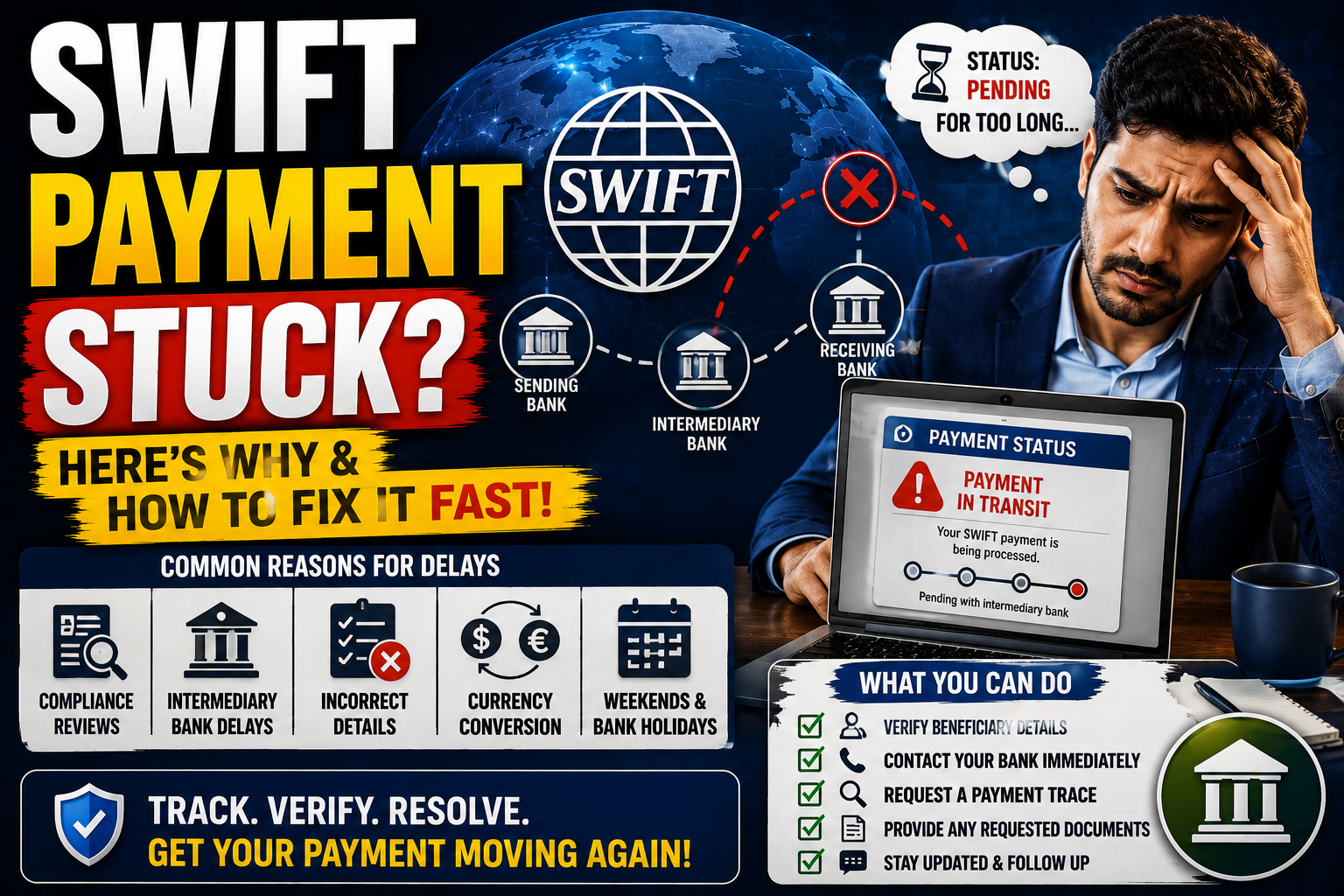
Learn why a SWIFT Payment Stuck issue happens, the most common causes of delays, how to track international wire transfers, and practical steps to resolve stuck SWIFT payments quickly.
Table of Contents
International wire transfers have become a vital part of the global financial system. Businesses use them to pay overseas suppliers, freelancers receive payments from international clients, families send money across borders, and investors move funds between financial institutions worldwide. Behind many of these transactions is the SWIFT network, one of the most widely used systems for secure international financial messaging.
Although SWIFT payments are generally reliable, delays can occasionally occur. A payment that normally arrives within a few business days may remain in a pending status for longer than expected, leaving both the sender and recipient wondering what happened. A SWIFT Payment Stuck situation can disrupt business operations, delay shipments, postpone investments, or create unnecessary financial uncertainty.
Unlike domestic bank transfers, SWIFT payments often pass through several financial institutions before reaching the recipient. Along the way, compliance reviews, incorrect payment details, intermediary bank processing, currency conversion, and regulatory checks can all contribute to delays.
In this guide, we’ll explain why a SWIFT Payment Stuck issue happens, how the SWIFT network processes international transfers, the most common reasons payments are delayed, how to track a SWIFT transfer, and the steps you can take to resolve the issue efficiently.
What Is a SWIFT Payment?
A SWIFT payment is an international bank transfer that uses the Society for Worldwide Interbank Financial Telecommunication (SWIFT) messaging network.
Contrary to popular belief, SWIFT does not actually move money between banks.
Instead, SWIFT securely sends standardized payment instructions between financial institutions around the world.
These messages tell participating banks:
- Who is sending the payment
- Who should receive the payment
- The payment amount
- The currency
- Payment references
- Settlement instructions
The actual transfer of funds occurs through the banking relationships established between participating financial institutions.
To learn more about the SWIFT network, visit:
SWIFT
What Does “SWIFT Payment Stuck” Mean?
A SWIFT Payment Stuck situation occurs when an international wire transfer takes significantly longer than expected to reach the recipient.
The payment may appear as:
- Pending
- Processing
- Under review
- Awaiting confirmation
- In transit
- Under compliance review
In most cases, the payment hasn’t disappeared—it simply hasn’t completed every stage of international processing.
How SWIFT Payments Work
Unlike many domestic bank transfers, SWIFT payments often involve multiple financial institutions.
A typical international transfer may include:
- Sending bank
- One or more correspondent (intermediary) banks
- Currency settlement institutions
- Receiving bank
Each institution performs its own verification procedures before forwarding the payment.
Because several organizations participate, processing can take longer than domestic transfers.
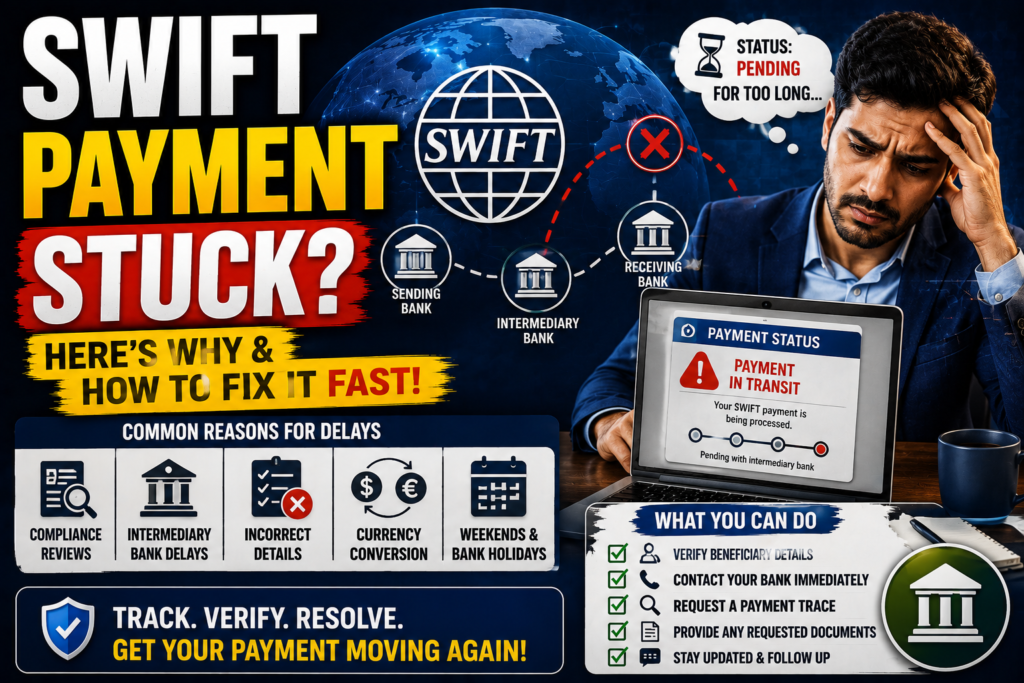
Common Reasons a SWIFT Payment Gets Stuck
Several factors can delay an international wire transfer.
Incorrect Beneficiary Information
One of the most common reasons for payment delays is inaccurate recipient information.
Examples include:
- Misspelled beneficiary name
- Incorrect account number
- Invalid IBAN
- Incorrect SWIFT/BIC code
- Wrong bank address
Even small errors may require manual review before processing continues.
Compliance Reviews
Banks must comply with international financial regulations designed to prevent:
- Money laundering
- Terrorist financing
- Financial crime
- Sanctions violations
- Fraud
If a transaction triggers additional compliance screening, processing may pause until the review is complete.
The Financial Action Task Force (FATF) establishes international anti-money laundering standards:
Correspondent Bank Delays
Many SWIFT payments travel through intermediary banks.
Each correspondent bank may:
- Verify transaction details
- Perform sanctions screening
- Conduct compliance checks
- Convert currencies
A delay at any stage can slow the entire transfer.
Currency Conversion
If the payment involves currency exchange, additional processing may be required.
Some banks only settle certain currencies during specific operating hours or through designated settlement partners.
Banking Holidays
International payments may pass through countries observing different:
- Public holidays
- Banking holidays
- Weekends
Even if the sending and receiving countries are operating normally, intermediary banks may be closed.
Large Transaction Amounts
High-value transfers often receive additional review.
Banks may request:
- Source of funds documentation
- Business invoices
- Contracts
- Identity verification
These checks help satisfy regulatory requirements.
Technical Issues
Occasionally, banks experience:
- System maintenance
- Network interruptions
- Processing backlogs
- Software updates
Although uncommon, technical issues can temporarily delay payments.
How Long Should a SWIFT Payment Take?
Processing times vary depending on:
- Countries involved
- Currencies
- Correspondent banks
- Compliance reviews
- Banking holidays
- Payment instructions
While many SWIFT payments are completed within a few business days, some transactions may require additional time due to the factors above.
How to Track a SWIFT Payment
Fortunately, international transfers can often be traced.
Useful information includes:
- Transaction reference number
- SWIFT message reference
- Payment date
- Amount
- Currency
- Sender information
- Beneficiary information
Your bank can often use this information to investigate the payment’s status.
Some financial institutions also provide online payment tracking services.
Learn more about global payment standards through the Bank for International Settlements (BIS):
What Should You Do If Your SWIFT Payment Is Stuck?
If your payment hasn’t arrived within the expected timeframe, follow these steps.
Contact Your Bank
Your sending bank should be your first point of contact.
Provide:
- Payment reference
- Date
- Amount
- Currency
- Recipient details
The bank can review transaction records and determine where the payment is currently located.
Verify Recipient Information
Ask the recipient to confirm:
- Bank account number
- IBAN
- SWIFT/BIC code
- Account name
- Bank name
Incorrect information is a common cause of delays.
Request a Payment Trace
Banks can initiate a SWIFT payment trace.
A trace allows participating financial institutions to determine where the payment currently resides within the international banking network.
Monitor Communication
If additional documentation is required, respond promptly.
Delays often occur because banks are waiting for:
- Identification documents
- Business invoices
- Compliance information
- Payment explanations
Quick responses can help accelerate processing.
Can a SWIFT Payment Be Cancelled?
Sometimes.
Cancellation depends on:
- Whether the receiving bank has already credited the funds.
- The stage of processing.
- The policies of the participating banks.
If cancellation is still possible, banks may charge administrative fees.
Can a SWIFT Payment Be Returned?
Yes.
Payments may be returned because of:
- Invalid account details
- Closed bank accounts
- Compliance rejection
- Currency restrictions
- Regulatory issues
Returned payments may take additional time to reach the sender’s account.
Tips to Avoid SWIFT Payment Delays
Many delays can be prevented through careful preparation.
Double-Check Payment Information
Always verify:
- Recipient name
- Account number
- IBAN
- SWIFT/BIC code
- Bank address
- Payment reference
Submit Complete Documentation
Business payments may require:
- Invoices
- Purchase orders
- Contracts
- Supporting documentation
Providing complete information reduces compliance delays.
Send Payments Early
Avoid initiating urgent transfers immediately before:
- Weekends
- Public holidays
- Financial reporting deadlines
Additional processing time provides a margin for unexpected delays.
Work With Reputable Banks
Established financial institutions often provide:
- Better payment tracking
- Experienced international payment teams
- Stronger customer support
- Faster issue resolution
Common Myths About SWIFT Payments
Myth 1: SWIFT Moves the Money
False.
SWIFT sends secure payment instructions.
The participating banks transfer the funds.
Myth 2: Every SWIFT Payment Takes the Same Time
False.
Processing depends on currencies, countries, correspondent banks, compliance reviews, and banking schedules.
Myth 3: A Delayed Payment Means It Has Been Lost
False.
Most delayed payments are eventually completed after additional verification or processing.
Frequently Asked Questions
What does SWIFT Payment Stuck mean?
It means an international wire transfer is taking longer than expected because of processing delays, compliance reviews, incorrect payment details, correspondent bank handling, or other operational factors.
Can I track a SWIFT payment?
Yes. Most banks can investigate a payment using the transaction reference number or SWIFT message reference.
Why is my international payment under review?
Banks routinely perform compliance and security checks to meet international regulations and protect against fraud, money laundering, and sanctions violations.
Can a delayed SWIFT payment still arrive?
Yes. Most delayed SWIFT payments are completed successfully once the necessary verification or processing steps have been completed.
Conclusion
A SWIFT Payment Stuck situation can be frustrating, especially when you’re waiting for an important international transfer. However, most delays are not caused by lost funds but by necessary processing steps such as compliance reviews, correspondent bank handling, currency conversion, or verification of payment details. Understanding how the SWIFT network operates helps set realistic expectations and makes it easier to identify the source of a delay.
If your payment is taking longer than expected, remain proactive by contacting your bank, verifying the recipient’s information, requesting a payment trace, and responding promptly to any requests for additional documentation. Careful preparation before initiating international transfers—such as confirming account details and allowing sufficient processing time—can significantly reduce the risk of future delays. By understanding the causes of SWIFT payment issues, individuals and businesses can navigate international banking with greater confidence and efficiency.
Learn why your Insurance Premium Increased unexpectedly, the common factors behind higher insurance costs, and practical ways to lower your premiums without sacrificing essential coverage.
