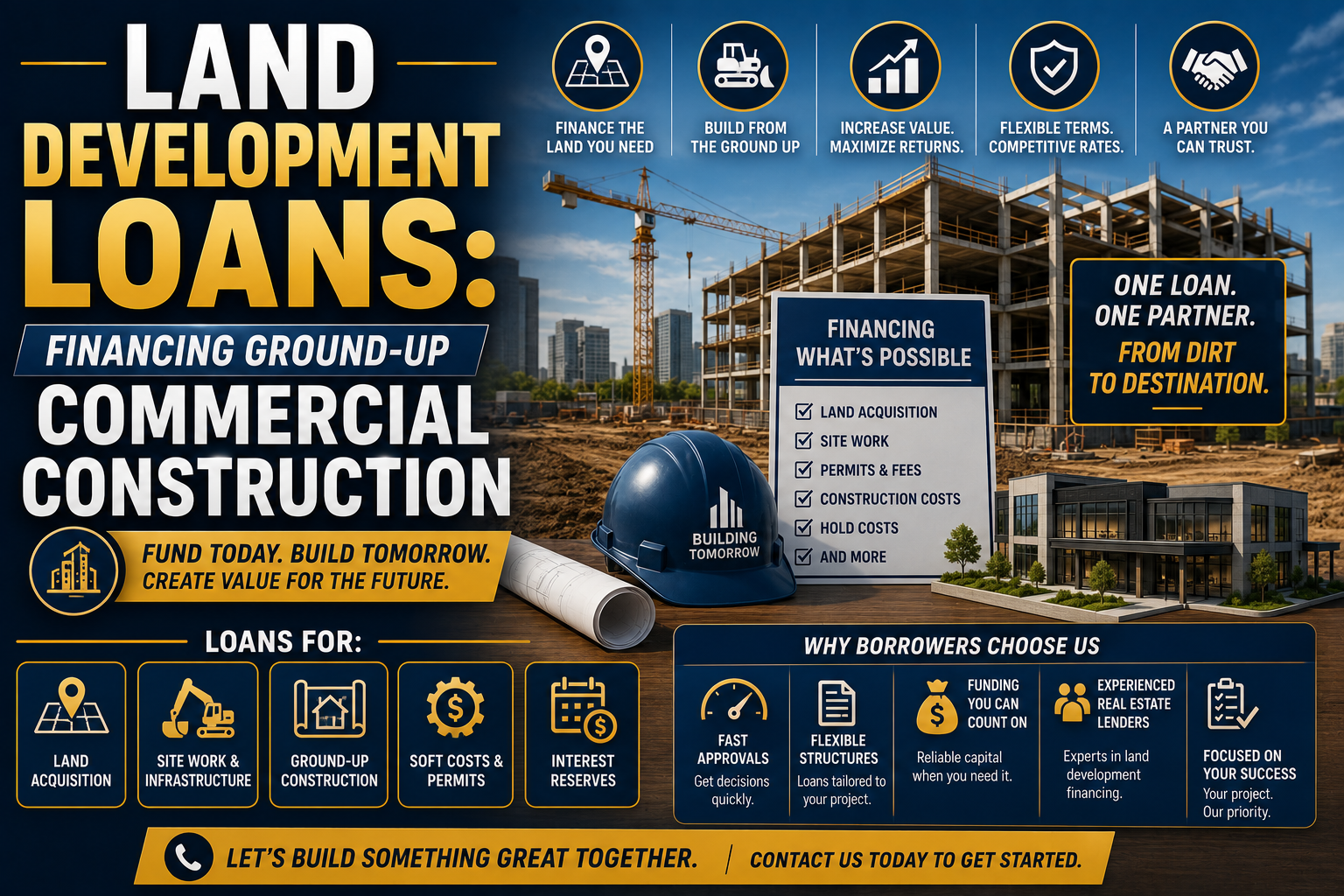
Discover how land development loans provide the essential capital needed to turn raw dirt into profitable commercial real estate properties.
Table of Contents
Finding a pristine piece of raw acreage with massive commercial potential is an incredible rush. You can already picture the modern retail plaza, industrial warehouse, or multi-family complex sitting proudly on the site. Then reality sets in. Raw land does not generate income on day one, municipal zoning permits are notoriously tricky, and grading a site requires deep capital before a single brick is ever laid. Traditional banks routinely turn their noses up at unbuilt dirt. If you want to transform raw acreage into a finished commercial asset, you need specialized land development loans to fund the journey.
Securing financing for ground-up construction is a completely different ballgame compared to buying a standing office building. Underwriters view raw dirt as high-risk collateral because there is no immediate cash flow to service the debt. Navigating this complex lending landscape requires a solid grasp of how land development loans actually function. Let us break down the exact mechanics, underwriting hurdles, and strategies needed to get your project funded without losing your sanity.
Why Raw Land Financing is Different
When a lender evaluates a standard commercial mortgage, they look at existing leases, current tenant rosters, and historical operating income. None of those metrics exist when you buy a vacant plot of trees and grass.
Because of this inherent uncertainty, financial institutions treat land development loans with extreme caution. They know that zoning delays, environmental reviews, or utility hookup snags can stall a project for months. Consequently, lenders demand lower loan-to-value ratios, higher equity contributions, and rigorous feasibility studies before approving a dime.
- Higher Equity Requirements: Expect lenders to ask for 30% to 50% down in cash or unencumbered equity.
- Staged Draw Schedules: Funds are disbursed in tranches as specific milestones—like grading, road paving, and utility installation—are completed.
- Stricter Underwriting: Underwriters scrutinize your development track record far more intensely than your personal credit score.
Mastering these core differences is essential before you walk into a bank asking for land development loans to support your commercial vision.
The Distinct Phases of Ground-Up Construction Funding
Financing a ground-up commercial project rarely happens in a single lump-sum payout. Instead, capital is deployed across distinct phases, each carrying its own unique risk profile and lending requirements.
Acquisition and Pre-Development Financing
This initial phase covers buying the raw land and handling early soft costs like architectural renderings, environmental impact reports, and zoning variances. Securing land development loans for this stage can be tough because the property generates zero income. Many developers rely on local private lenders or relationship banks who understand the local municipal landscape. You can review guidelines on real estate development to better understand how pre-development phases interact with zoning laws.
Infrastructure and Site Work
Once you own the dirt, the heavy lifting begins. You have to grade the topography, install storm drainage, pour concrete access roads, and pull utility lines to the property edge. This is where specialized land development loans truly shine, providing the staged capital necessary to turn raw land into ready-to-build paper lots.
Horizontal to Vertical Transition
Once the horizontal infrastructure is complete, your land is officially shovel-ready. At this juncture, developers typically transition their financing package into a traditional commercial construction loan to fund the actual vertical building structures. You can check insights on construction loans to see how short-term building debt transitions into permanent commercial mortgages.
What Lenders Look For in Your Application
Underwriters reviewing applications for land development loans are essentially betting on your execution capability. Even if the real estate market looks phenomenal, a weak sponsor team will kill a deal instantly.
- Proven Track Record: Lenders want proof that you have successfully completed similar commercial projects on time and within budget.
- Comprehensive Feasibility Study: You must provide clear market data proving local demand for your finished commercial product.
- Experienced General Contractor: Having a respected, bonded GC attached to your loan application builds immense confidence.
Presenting a clean, detailed package makes underwriting land development loans far smoother and accelerates your path to closing.
Common Pitfalls That Derail Projects
Even seasoned developers occasionally run into avoidable roadblocks that delay funding or kill project profitability entirely.
- Underestimating Soft Costs: Permitting fees, environmental impact studies, and municipal impact fees always cost more than initial estimates.
- Failing Contingency Budgets: Not setting aside a robust 10% to 15% cash contingency fund leaves you vulnerable to sudden supply chain spikes.
- Ignoring Environmental Red Flags: Finding protected wetlands or endangered species on your site after closing can halt construction indefinitely.
Avoiding these common mistakes ensures your land development loans remain fully funded and your construction timeline stays on track.
FAQs
What is the difference between a land loan and a construction loan?
A basic land loan simply finances the purchase of raw, unimproved dirt. In contrast, land development loans provide capital to actively improve that dirt by adding roads, utilities, grading, and subdivision infrastructure before building begins.
How much down payment do I need for ground-up development?
Lenders typically view raw land as a high-risk asset class, requiring a down payment or equity contribution ranging anywhere from 30% to 50% of the total project cost.
Can I finance infrastructure and building construction at the same time?
Sometimes. Many lenders offer combination acquisition-and-development loans, though many commercial projects split the financing into horizontal land development loans first, followed by vertical construction financing later.
How do lenders disburse funds during the project?
Funds are rarely handed over all at once. Lenders release cash through controlled draw schedules, sending an independent inspector to verify that specific milestones—such as utility trenching or road paving—are completed before unlocking the next tranche.
What is the biggest reason development loans get rejected?
The most frequent causes for denial are weak sponsor experience, incomplete municipal zoning approvals, or lack of a comprehensive feasibility study proving actual commercial market demand.
Conclusion
Turning raw, empty acreage into a thriving commercial property is one of the most challenging yet rewarding endeavors in real estate. It requires patience, meticulous planning, and substantial capital. While navigating municipal approvals and underwriting hurdles can test your resolve, having the right financial partner makes all the difference. Ultimately, securing reliable land development loans provides the foundation, structure, and momentum needed to bring your commercial vision out of the dirt and into reality.
