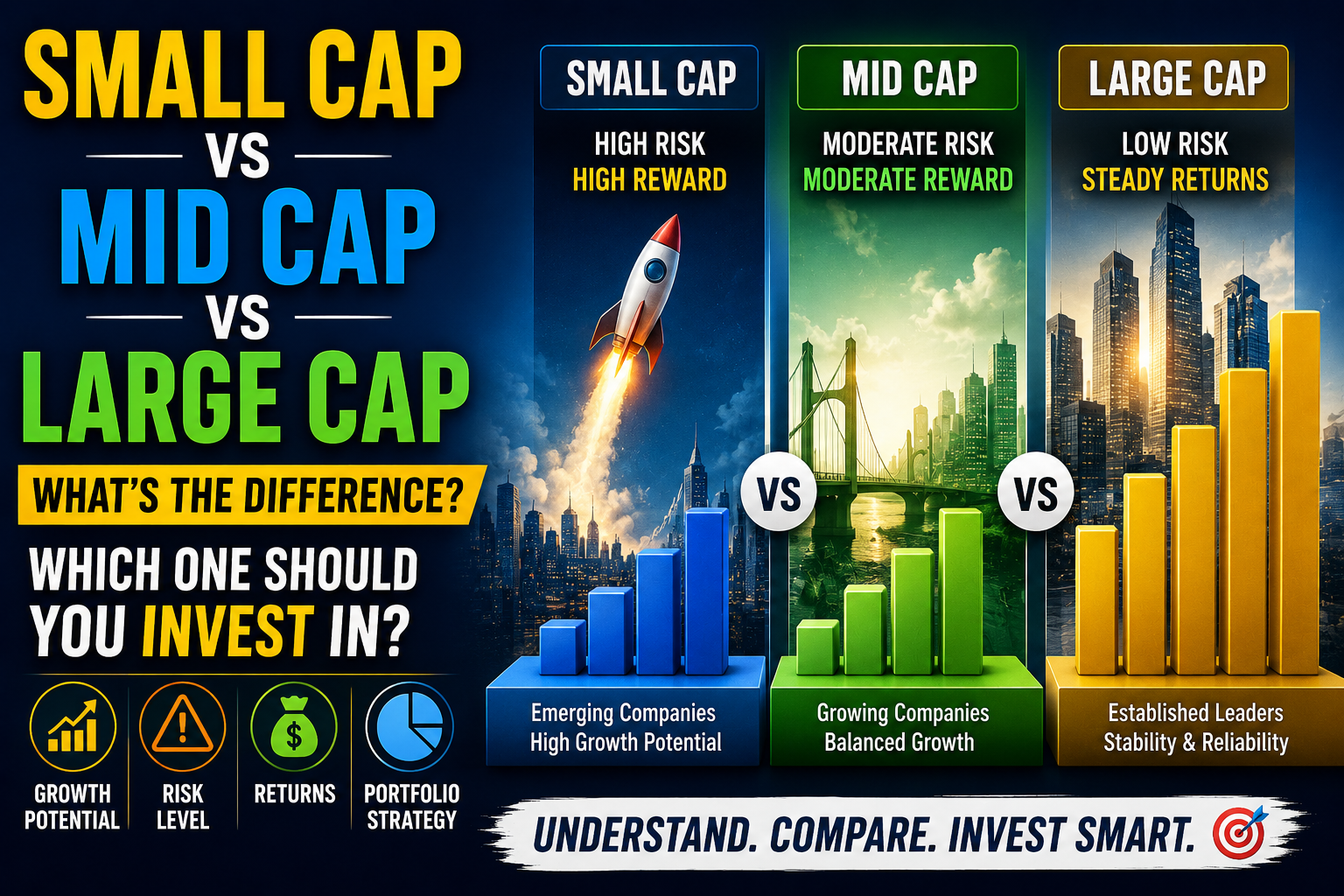
Learn the difference between Small Cap vs Mid Cap vs Large Cap stocks, including their risks, returns, benefits, and which investment category best suits your financial goals.
Table of Contents
If you’ve recently started investing in the stock market, you’ve likely encountered terms like Small Cap, Mid Cap, and Large Cap. These categories appear everywhere—from financial news and investment reports to mutual fund recommendations—but many investors don’t fully understand what they mean or why they matter.
The truth is, market capitalization plays a significant role in determining a company’s growth potential, investment risk, and long-term returns. Whether you’re building your first investment portfolio or refining an existing one, understanding the differences between these three categories can help you make smarter financial decisions.
In this guide, we’ll explain what Small Cap, Mid Cap, and Large Cap stocks are, how they’re classified, their advantages and disadvantages, and which type of investor each category is best suited for.
What Does “Market Cap” Mean?
Before comparing the three categories, it’s important to understand market capitalization, commonly known as market cap.
Market capitalization represents the total market value of a company’s outstanding shares.
Formula:
Market Capitalization = Current Share Price × Total Outstanding Shares
For example, if a company has one billion outstanding shares trading at $100 each, its market capitalization is $100 billion.
Market cap doesn’t measure a company’s revenue or profit. Instead, it reflects how much investors believe the company is worth in the stock market.
To learn more about market capitalization, visit the official SEC Investor Education website:
https://www.investor.gov/introduction-investing
What Are Large Cap Stocks?
Large Cap stocks belong to the world’s biggest publicly traded companies. These businesses have established brands, stable earnings, global operations, and strong financial performance.
Most Large Cap companies have survived multiple economic cycles and are considered the foundation of many investment portfolios.
Global Examples
- Apple
- Microsoft
- NVIDIA
- Amazon
- Alphabet (Google)
- Saudi Aramco
- Meta Platforms
- Berkshire Hathaway
These companies dominate their industries and often influence global markets.
Advantages of Large Cap Stocks
- Lower investment risk
- Strong financial stability
- Consistent revenue growth
- Higher liquidity
- Regular dividend payments (many companies)
- Better resilience during economic downturns
Disadvantages
- Slower growth compared to smaller companies
- Limited chances of extremely high returns
- Mature businesses often grow at a slower pace
Large Cap stocks are generally ideal for investors seeking long-term stability and lower volatility.
What Are Mid Cap Stocks?
Mid Cap companies fall between established industry leaders and emerging businesses. They have already proven their business models but still possess significant growth potential.
Many of today’s largest corporations were once Mid Cap companies.
These businesses often expand into new markets, launch innovative products, or increase global operations, making them attractive to growth investors.
Examples
- Duolingo
- GitLab
- Crocs
- Elastic
- Celsius Holdings
(Examples may change over time as companies move between market-cap categories.)
Advantages of Mid Cap Stocks
- Higher growth potential than Large Caps
- More stable than Small Caps
- Opportunity to become future market leaders
- Better balance between risk and return
Disadvantages
- More volatile than Large Caps
- Earnings can fluctuate during economic slowdowns
- Less financial flexibility than multinational corporations
Mid Cap stocks are often considered the “sweet spot” for investors looking for both growth and reasonable stability.
What Are Small Cap Stocks?
Small Cap stocks represent smaller publicly listed companies that are still in their growth phase.
These businesses typically operate in emerging industries, niche markets, or rapidly expanding sectors. Because they’re smaller, they often have greater room for expansion—but also face higher risks.
Small Cap companies may eventually become Mid Cap or even Large Cap businesses if they continue growing successfully.
Advantages of Small Cap Stocks
- Highest long-term growth potential
- Opportunity for multi-bagger returns
- Faster revenue growth
- Greater innovation
- Potential takeover targets
Disadvantages
- High volatility
- Greater business uncertainty
- Lower trading liquidity
- More sensitive to economic downturns
- Higher bankruptcy risk
Small Cap investing requires patience, thorough research, and a willingness to accept larger price fluctuations.
Small Cap vs Mid Cap vs Large Cap: Key Differences
| Feature | Large Cap | Mid Cap | Small Cap |
|---|---|---|---|
| Company Size | Largest | Medium | Small |
| Risk Level | Low | Moderate | High |
| Growth Potential | Moderate | High | Very High |
| Volatility | Low | Medium | High |
| Dividend Potential | High | Moderate | Low |
| Financial Stability | Strong | Good | Limited |
| Liquidity | High | Moderate | Lower |
| Best For | Conservative investors | Balanced investors | Aggressive investors |
Why Do Small Cap Stocks Offer Higher Return Potential?
Smaller companies have much more room to grow.
A company worth $500 million can realistically become a $5 billion business over the next decade. However, it’s much harder for a $3 trillion company to increase its value tenfold.
That’s why Small Cap stocks often generate exceptional returns during strong economic periods.
However, higher return potential always comes with higher risk. Many Small Cap companies never achieve their expected growth, making careful research essential.
Which Category Performs Best During Different Market Cycles?
During Bull Markets
When the economy is expanding and investor confidence is high, Small Cap and Mid Cap stocks often outperform because investors are willing to take on more risk.
During Bear Markets
Large Cap companies generally perform better during market downturns because they have stronger balance sheets, diversified revenue streams, and better access to capital.
This is one reason many investors increase their exposure to Large Cap stocks during uncertain economic conditions.
How Should You Allocate Your Portfolio?
There is no single “best” allocation. It depends on your goals, investment horizon, and risk tolerance.
Conservative Investors
- 70–80% Large Cap
- 20–30% Mid Cap
- Minimal Small Cap exposure
Moderate Investors
- 50% Large Cap
- 30% Mid Cap
- 20% Small Cap
Aggressive Investors
- 30% Large Cap
- 40% Mid Cap
- 30% Small Cap
These are general examples rather than strict rules. Diversification remains one of the most effective ways to manage investment risk.
Learn more about diversification from Morningstar:
https://www.morningstar.com
Common Mistakes Investors Make
Many new investors focus only on potential returns while ignoring risk.
Some common mistakes include:
- Investing only in Small Cap stocks hoping for quick profits
- Ignoring diversification
- Buying companies based solely on social media hype
- Chasing past performance
- Panic selling during market corrections
- Not reviewing portfolio allocation regularly
Successful investing is usually about consistency, discipline, and long-term thinking rather than finding the next “hot stock.”
Which Is Better: Small Cap, Mid Cap, or Large Cap?
There isn’t a universal winner.
If you want stability and lower risk, Large Cap stocks may be the right choice.
If you’re seeking a balance between growth and safety, Mid Cap stocks often provide an attractive middle ground.
If you have a long investment horizon and can tolerate higher volatility, Small Cap stocks may offer the greatest long-term growth potential.
Many experienced investors combine all three categories to build a diversified portfolio capable of performing across different market conditions.
Frequently Asked Questions
What is the main difference between Small Cap, Mid Cap, and Large Cap stocks?
The primary difference is market capitalization. Large Cap companies are the biggest publicly traded businesses, Mid Cap companies are medium-sized businesses with growth potential, and Small Cap companies are smaller firms that typically carry higher risk and higher potential returns.
Are Small Cap stocks riskier than Large Cap stocks?
Yes. Small Cap stocks are generally more volatile and financially less stable than Large Cap companies, making them riskier investments.
Which category is best for beginners?
Many financial professionals recommend starting with Large Cap stocks because they tend to be more stable and less volatile than Mid Cap or Small Cap investments.
Can a Small Cap company become a Large Cap company?
Absolutely. Many of today’s largest global companies started as small businesses and gradually grew into Large Cap corporations over time.
Conclusion
Understanding Small Cap vs Mid Cap vs Large Cap is one of the most important concepts for any investor. These categories don’t simply describe the size of a company—they reflect different levels of risk, growth potential, and market maturity.
Large Cap stocks provide stability and consistent performance, Mid Cap stocks offer a balance of growth and resilience, while Small Cap stocks present exciting opportunities alongside greater uncertainty.
Rather than choosing just one category, many successful investors diversify across all three. A well-balanced portfolio can help reduce risk while capturing opportunities across different stages of the business lifecycle.
Before investing, always evaluate your financial goals, time horizon, and risk tolerance, and rely on trusted sources such as the U.S. Securities and Exchange Commission (https://www.investor.gov) and Nasdaq’s Investor Education (https://www.nasdaq.com) to continue building your investment knowledge.
Discover how cost segregation studies accelerate depreciation deductions, reduce taxable income, and maximize cash flow for commercial property owners.
