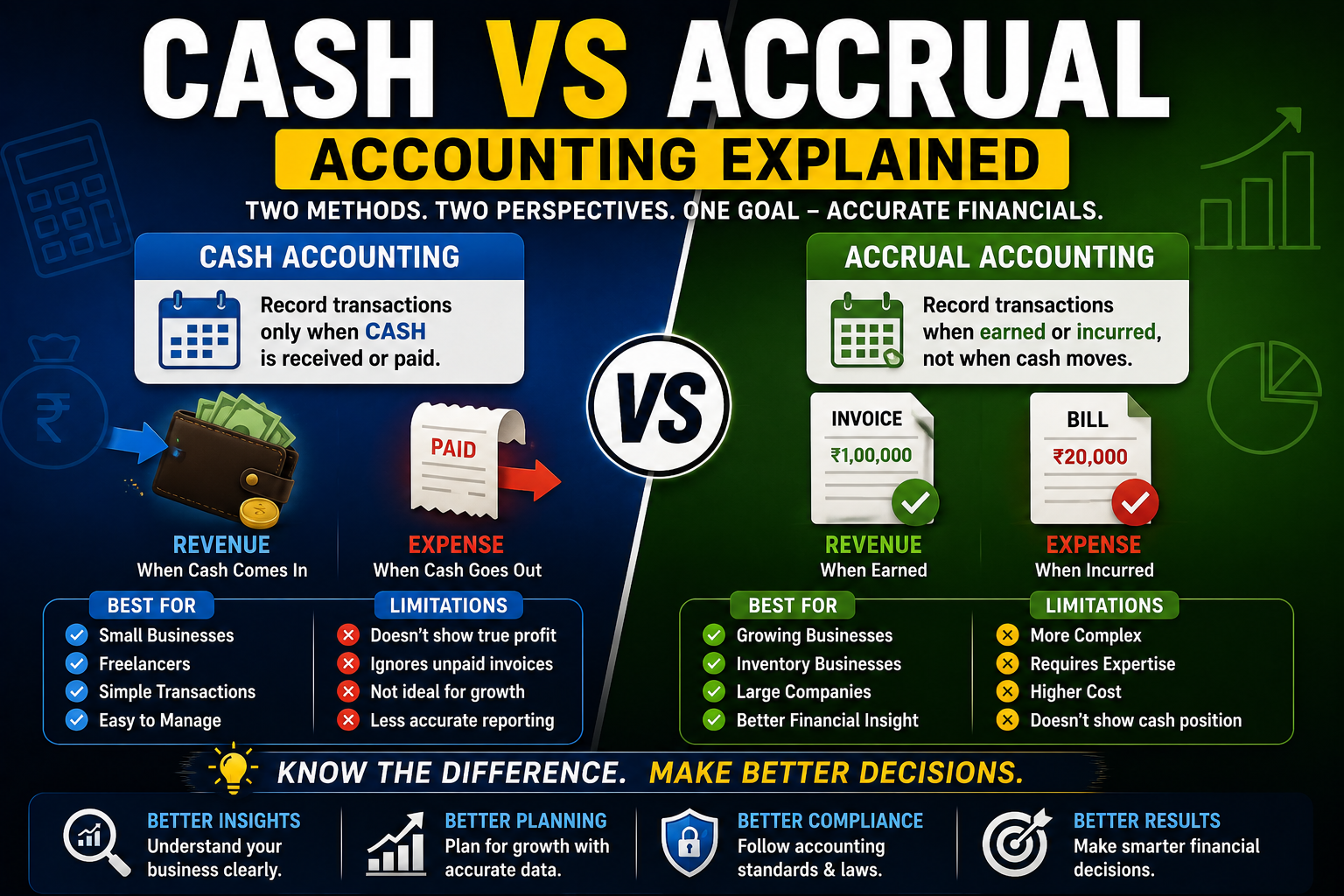
Learn the difference between Cash vs Accrual Accounting, how each accounting method works, their advantages, disadvantages, and which approach is best for businesses and investors.
Table of Contents
Accounting is often called the language of business, and one of the first concepts every entrepreneur, investor, and finance professional should understand is the difference between Cash vs Accrual Accounting.
At first glance, both accounting methods appear to achieve the same goal—tracking a company’s income and expenses. However, they record financial transactions at different points in time, which can significantly affect reported revenue, profits, taxes, and overall financial performance.
Imagine a company sells products worth $100,000 in December but receives payment in January. Should the revenue be recorded in December, when the sale occurred, or in January, when the cash arrived? The answer depends on the accounting method being used.
Understanding these differences is essential because they influence how businesses report financial results, how investors evaluate companies, and how managers make strategic decisions.
In this guide, we’ll explain Cash vs Accrual Accounting, explore their advantages and disadvantages, compare them side by side, and discuss which accounting method is most appropriate for different types of businesses.
What Is Cash Accounting?
Cash Accounting is one of the simplest accounting methods.
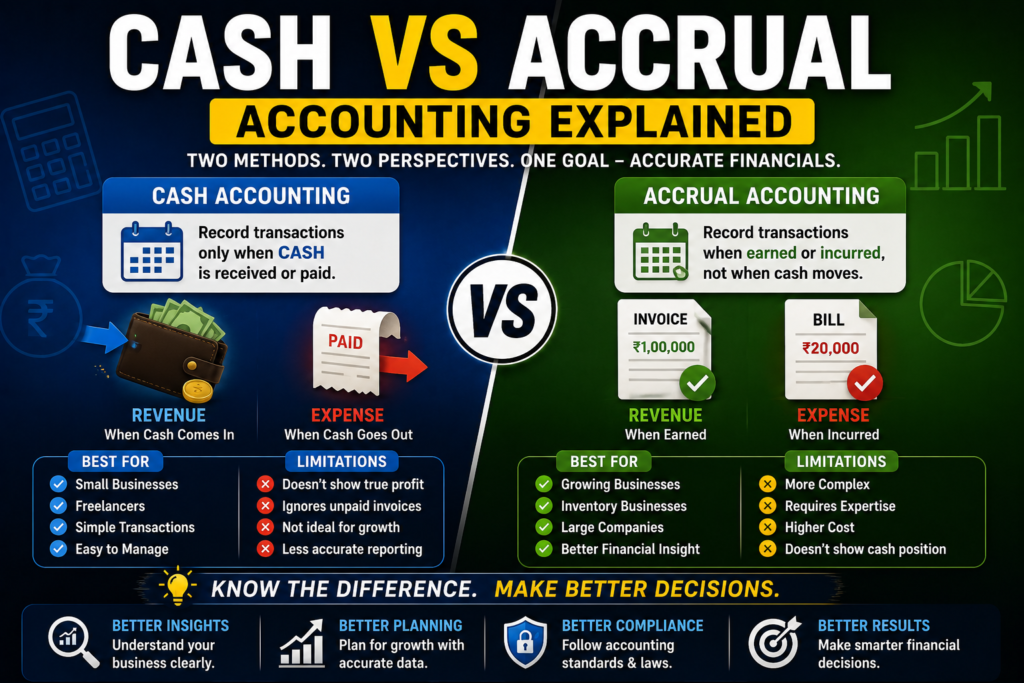
Under this approach, revenue is recorded only when cash is actually received, and expenses are recorded only when cash is paid.
In other words, financial transactions are recognized based solely on the movement of cash.
For example:
- You provide consulting services in December.
- Your client pays you in January.
Under Cash Accounting, the revenue is recorded in January, because that’s when the cash is received.
Similarly, if you receive a supplier invoice in March but pay it in April, the expense is recorded in April.
Cash accounting reflects the actual cash available in the business rather than outstanding invoices or future obligations.
How Cash Accounting Works
Consider a freelance graphic designer.
- Project completed: March 15
- Invoice sent: March 16
- Client pays: April 10
Using Cash Accounting:
Revenue is recognized in April, not March.
Now suppose the designer purchases software:
- Software purchased: May 1
- Payment made: May 25
The expense is recorded in May, when payment is made.
This straightforward approach makes Cash Accounting easy to understand and maintain.
Advantages of Cash Accounting
Cash Accounting offers several benefits, especially for smaller businesses.
Simple to Maintain
Since only cash transactions are recorded, bookkeeping is easier and requires less accounting knowledge.
Clear Cash Position
Business owners always know how much cash is actually available.
There are no complicated adjustments for unpaid invoices or future obligations.
Easier Budget Management
Tracking actual cash inflows and outflows helps businesses manage day-to-day expenses more effectively.
Tax Timing Benefits
In some jurisdictions, businesses may defer taxable income by delaying customer payments until the following accounting period, where permitted by tax laws.
Always consult a qualified tax professional regarding applicable regulations.
Disadvantages of Cash Accounting
Despite its simplicity, Cash Accounting has important limitations.
Doesn’t Reflect Actual Business Performance
Revenue may fluctuate simply because customers pay earlier or later.
This can make profitable businesses appear less profitable during certain periods.
Ignores Outstanding Invoices
Accounts receivable and accounts payable aren’t recorded until cash changes hands.
This provides an incomplete picture of future obligations and expected income.
Limited for Growing Businesses
As businesses expand, Cash Accounting often becomes less useful because financial statements no longer accurately represent operational performance.
What Is Accrual Accounting?
Accrual Accounting records revenue when it is earned and expenses when they are incurred, regardless of when cash is received or paid.
Instead of tracking cash movement, this method follows the economic activity of the business.
Most publicly traded companies worldwide prepare financial statements using Accrual Accounting because it provides a more accurate picture of financial performance.
To learn more about global accounting standards, visit the IFRS Foundation:
How Accrual Accounting Works
Suppose a software company signs a contract worth $50,000 in November.
The customer agrees to pay in January.
Using Accrual Accounting:
Revenue is recognized in November, because that’s when the service was provided.
Similarly:
A company receives electricity services in December but pays the utility bill in January.
The expense is recognized in December, because that’s when the cost was incurred.
This approach better matches revenues with the expenses required to generate them.
Matching Principle
One of the most important concepts in Accrual Accounting is the Matching Principle.
It states that expenses should be recorded during the same accounting period as the revenue they helped generate.
For example:
A manufacturer spends $40,000 producing products sold in June.
Even if supplier payments occur in July, those production costs belong in June because they generated June’s sales.
This principle improves the accuracy of financial reporting.
Advantages of Accrual Accounting
More Accurate Financial Statements
Revenue and expenses are recorded when business activity occurs rather than when cash moves.
Better Performance Analysis
Investors and managers gain a clearer understanding of profitability.
Improved Long-Term Planning
Businesses can identify trends, forecast revenue, and evaluate operational efficiency more effectively.
Required for Most Public Companies
Most large corporations prepare financial statements under accrual accounting standards such as IFRS or US GAAP.
Learn more about accounting standards through the Financial Accounting Standards Board (FASB):
Disadvantages of Accrual Accounting
More Complex
Businesses must track:
- Accounts Receivable
- Accounts Payable
- Deferred Revenue
- Accrued Expenses
- Inventory
- Depreciation
This requires stronger accounting systems.
Doesn’t Reflect Available Cash
A company may report large profits while having limited cash available.
This is why investors also analyze the Cash Flow Statement.
Higher Administrative Costs
Professional bookkeeping and accounting software are often necessary.
Cash vs Accrual Accounting: Key Differences
| Feature | Cash Accounting | Accrual Accounting |
|---|---|---|
| Revenue Recognition | When cash is received | When revenue is earned |
| Expense Recognition | When cash is paid | When expenses are incurred |
| Complexity | Low | High |
| Accuracy | Moderate | High |
| Cash Tracking | Excellent | Moderate |
| Financial Reporting | Basic | Comprehensive |
| Suitable For | Small businesses & freelancers | Growing businesses & public companies |
Which Accounting Method Is Better?
There is no universal answer.
The right accounting method depends on the size, complexity, and objectives of the business.
Cash Accounting may be suitable for:
- Freelancers
- Consultants
- Sole proprietors
- Small service businesses
- Businesses with simple transactions
Accrual Accounting may be more appropriate for:
- Public companies
- Manufacturing businesses
- Retail chains
- Large corporations
- Companies with inventory
- Businesses offering customer credit
As businesses grow, many transition from Cash Accounting to Accrual Accounting to provide more meaningful financial information.
Why Investors Prefer Accrual Accounting
Professional investors generally rely on accrual-based financial statements because they provide a more complete picture of business performance.
Accrual Accounting captures:
- Outstanding customer payments
- Future obligations
- Revenue earned but not yet collected
- Expenses incurred but not yet paid
This helps investors evaluate profitability without being misled by temporary cash timing differences.
Real-World Example
Imagine two companies each generate $1 million in sales during December.
Company A (Cash Accounting)
Customers pay in January.
December revenue:
$0
January revenue:
$1 million
Company B (Accrual Accounting)
Revenue is recognized when products are delivered.
December revenue:
$1 million
January revenue:
$0
Although both companies earned the same amount, their reported financial results differ significantly depending on the accounting method.
Common Mistakes Beginners Make
Many new business owners misunderstand accounting methods.
Common mistakes include:
- Assuming profit equals cash.
- Ignoring unpaid customer invoices.
- Forgetting future liabilities.
- Confusing revenue with cash receipts.
- Choosing an accounting method without considering business growth.
Understanding these differences helps business owners make better financial decisions.
Frequently Asked Questions
What is the difference between Cash vs Accrual Accounting?
Cash Accounting records transactions when cash changes hands, while Accrual Accounting records revenue when earned and expenses when incurred.
Why do public companies use Accrual Accounting?
Accrual Accounting provides a more accurate representation of financial performance and complies with major accounting standards such as IFRS and US GAAP.
Is Cash Accounting easier?
Yes. Cash Accounting is generally simpler because it records only actual cash receipts and payments.
Which accounting method is better for investors?
Most investors prefer Accrual Accounting because it presents a more complete picture of a company’s financial health and operating performance.
Conclusion
Understanding Cash vs Accrual Accounting is essential for entrepreneurs, investors, accountants, and anyone involved in financial decision-making. While Cash Accounting offers simplicity and clear visibility into available cash, Accrual Accounting provides a more accurate representation of a company’s true financial performance by recognizing revenue and expenses when they occur.
Each method serves a different purpose. Small businesses and freelancers often benefit from the straightforward nature of Cash Accounting, whereas larger organizations and publicly traded companies rely on Accrual Accounting to meet reporting standards and provide meaningful financial insights. By understanding the strengths and limitations of both approaches, business owners can choose the method that best fits their needs, and investors can better interpret financial statements when evaluating companies.
Discover how to scale your real estate portfolio safely by unlocking equity and leveraging a Home Equity Line of Credit (HELOC) on rentals.
