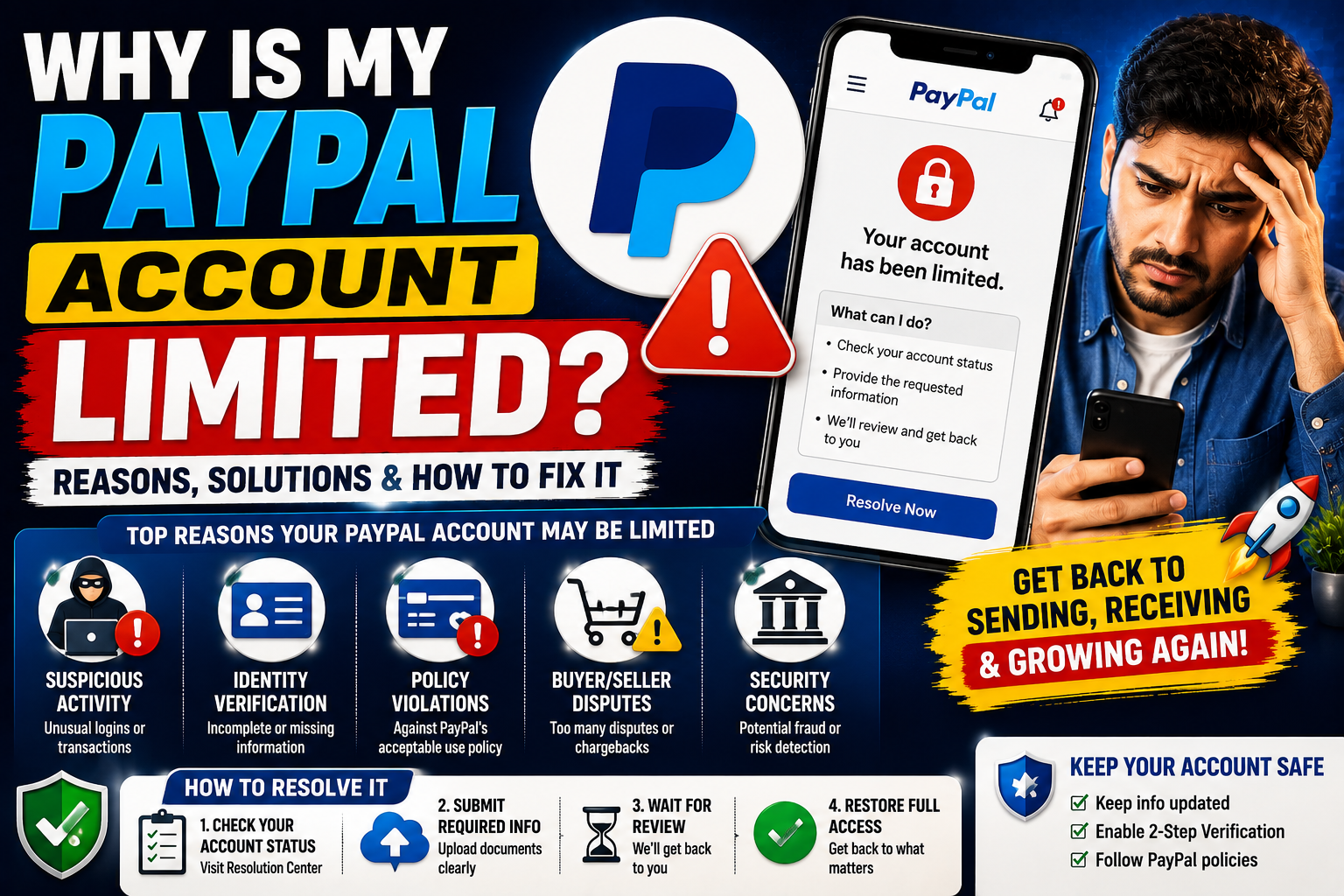
Learn why your PayPal Account Limited notification appears, the most common reasons for account limitations, how to remove restrictions, and practical tips to prevent future limitations.
Table of Contents
PayPal is one of the world’s most widely used online payment platforms, allowing millions of individuals and businesses to send money, receive payments, shop online, and conduct international transactions securely. Its convenience and global reach have made it a preferred payment solution for freelancers, e-commerce businesses, digital creators, and everyday consumers.
However, many users are surprised to log into their accounts and see a notification stating that their PayPal Account Limited. Suddenly, they may be unable to send payments, withdraw funds, receive money, or access certain account features.
Although this can be frustrating, an account limitation doesn’t always mean you’ve violated PayPal’s policies intentionally. In many cases, limitations are temporary security measures designed to protect users, comply with financial regulations, or verify account activity.
Understanding why PayPal limits accounts, how the review process works, and what steps you can take to restore full account access can help you resolve the issue more quickly and reduce the chances of future restrictions.
In this guide, we’ll explain the most common reasons a PayPal Account Limited notice appears, how to remove limitations, and best practices for maintaining a healthy PayPal account.
What Does “PayPal Account Limited” Mean?
A PayPal Account Limited status means PayPal has temporarily restricted some or all account functions while it reviews certain activities or requests additional information.
Depending on the limitation, users may temporarily lose the ability to:
- Send money
- Receive payments
- Withdraw funds
- Make purchases
- Accept customer payments
- Close the account
- Transfer money to a bank account
The exact restrictions depend on the reason for the limitation.
Learn more about PayPal account limitations through the official PayPal Help Center:
Why Does PayPal Limit Accounts?
PayPal operates in hundreds of countries and must comply with international financial regulations designed to prevent fraud, money laundering, identity theft, and unauthorized transactions.
Account limitations help PayPal:
- Protect customer accounts
- Verify identities
- Detect suspicious activity
- Prevent financial fraud
- Comply with anti-money laundering regulations
- Meet global financial compliance requirements
Many limitations are automatically triggered by PayPal’s security systems.
Common Reasons a PayPal Account Limited Notification Appears
Several situations may cause PayPal to temporarily restrict an account.
Unusual Account Activity
If PayPal detects activity that differs significantly from your normal account behavior, it may temporarily limit access.
Examples include:
- Large unexpected transactions
- Multiple payments within a short period
- International logins
- Unusual withdrawal activity
- Rapid increases in sales volume
These reviews help verify that the account owner initiated the activity.
Identity Verification
Financial regulations often require payment providers to verify customer identities.
PayPal may request documents such as:
- Government-issued identification
- Proof of address
- Business registration documents
- Tax information
Until verification is completed, certain account features may remain restricted.
Suspicious Login Attempts
Logging in from:
- New countries
- Unknown devices
- Public Wi-Fi networks
- VPN services
may trigger additional security checks.
If PayPal believes someone else may be accessing your account, it may temporarily limit activity to protect your funds.
Buyer or Seller Disputes
Frequent customer disputes, chargebacks, or refund requests may increase account risk.
For business accounts, excessive disputes can lead to temporary limitations while PayPal reviews account activity.
Policy Violations
PayPal’s Acceptable Use Policy prohibits certain types of transactions.
Examples may include:
- Counterfeit goods
- Fraudulent activities
- Certain regulated products
- Illegal transactions
- Intellectual property violations
Violations may result in temporary or permanent account restrictions.
Review PayPal’s Acceptable Use Policy here:
https://www.paypal.com/us/legalhub/acceptableuse-full
Incomplete Account Information
Missing information may also trigger limitations.
Examples include:
- Unconfirmed email address
- Unverified phone number
- Outdated contact information
- Expired identification documents
Keeping account information current helps reduce security concerns.
How to Know Why Your Account Is Limited
PayPal usually explains the reason for an account limitation inside your account dashboard.
The Resolution Center may display:
- Required documents
- Requested actions
- Verification steps
- Deadlines
- Account status updates
Always review these instructions carefully before taking further action.
How to Remove a PayPal Account Limitation
In many cases, limitations can be resolved by completing the requested verification steps.
Step 1: Log Into Your PayPal Account
Access your account only through PayPal’s official website or mobile app.
Avoid clicking links received through suspicious emails or text messages.
Step 2: Visit the Resolution Center
The Resolution Center explains:
- Why your account was limited
- What documents are required
- Which actions must be completed
Follow the instructions exactly as provided.
Step 3: Submit Requested Documents
Depending on your situation, PayPal may request:
- Passport
- Driver’s license
- National identity card
- Utility bill
- Bank statement
- Business registration
- Tax documentation
Submit clear, accurate, and up-to-date documents.
Step 4: Wait for Review
After submitting information, PayPal reviews the documentation.
Review times vary depending on:
- Account type
- Complexity of the review
- Document quality
- Regulatory requirements
Monitor your account for updates.
Step 5: Respond Quickly to Additional Requests
Sometimes PayPal requests additional clarification.
Providing requested information promptly may help speed up the review process.
Can You Still Receive Money During a Limitation?
It depends on the specific restriction.
Some account limitations allow users to:
- Receive payments
- View balances
while restricting:
- Withdrawals
- Sending money
- Transfers
Other limitations may temporarily suspend nearly all account activity.
Always review the specific restrictions shown in your account.
Can PayPal Permanently Limit an Account?
Yes.
Serious or repeated violations of PayPal’s policies may result in a permanent account limitation.
Examples include:
- Fraud
- Identity theft
- Money laundering
- Prohibited business activities
- Repeated policy violations
Permanent limitations are different from temporary security reviews.
How to Prevent Future Account Limitations
Maintaining a healthy PayPal account is the best long-term strategy.
Keep Your Information Updated
Regularly review:
- Address
- Phone number
- Email address
- Bank account
- Linked payment cards
Verify Your Identity
Complete identity verification as early as possible rather than waiting until PayPal requests it.
Protect Your Account
Enable:
- Two-factor authentication (2FA)
- Strong passwords
- Login notifications
These features improve account security.
Learn more about online account protection through the Cybersecurity and Infrastructure Security Agency (CISA):
Avoid Suspicious Activity
Large, unusual transactions may trigger additional reviews.
If your business experiences sudden growth, maintaining accurate documentation can help support future verification requests.
Follow PayPal Policies
Read and understand PayPal’s:
- User Agreement
- Acceptable Use Policy
- Seller Protection rules
- Buyer Protection policies
Following platform rules helps reduce account risk.
Common Myths About PayPal Account Limitations
Myth 1: A Limited Account Means I’ve Been Banned
False.
Many limitations are temporary and designed to verify information or protect account security.
Myth 2: PayPal Limits Accounts Randomly
False.
Most limitations result from automated risk detection systems, regulatory requirements, or missing information.
Myth 3: Creating a New Account Solves the Problem
Not necessarily.
Creating additional accounts without resolving existing issues may violate PayPal’s policies and create further complications.
Frequently Asked Questions
What does PayPal Account Limited mean?
It means PayPal has temporarily restricted certain account functions while reviewing activity or requesting additional verification.
How long does a PayPal limitation last?
The timeframe varies depending on the reason for the limitation and how quickly the requested information is provided.
Can I remove a PayPal account limitation?
In many cases, yes. Completing the requested verification steps and submitting the required documentation can restore account access.
Why did PayPal suddenly limit my account?
Common reasons include unusual transaction activity, identity verification requirements, suspicious logins, policy reviews, or missing account information.
Conclusion
Seeing a PayPal Account Limited notification can be concerning, but in many cases it is simply a temporary security measure rather than a permanent restriction. PayPal uses automated monitoring systems and regulatory compliance procedures to protect users, prevent fraud, and ensure that transactions comply with international financial standards. As a result, account limitations often occur because of identity verification requests, unusual account activity, incomplete information, or additional security checks.
The best way to resolve a limitation is to carefully review the instructions in PayPal’s Resolution Center, submit any requested documentation promptly, and ensure that all account information remains accurate and up to date. By understanding why account limitations occur and following PayPal’s policies and security recommendations, individuals and businesses can reduce the likelihood of future restrictions while continuing to use the platform safely and confidently.
Learn why a SWIFT Payment Stuck issue happens, the most common causes of delays, how to track international wire transfers, and practical steps to resolve stuck SWIFT payments quickly.
