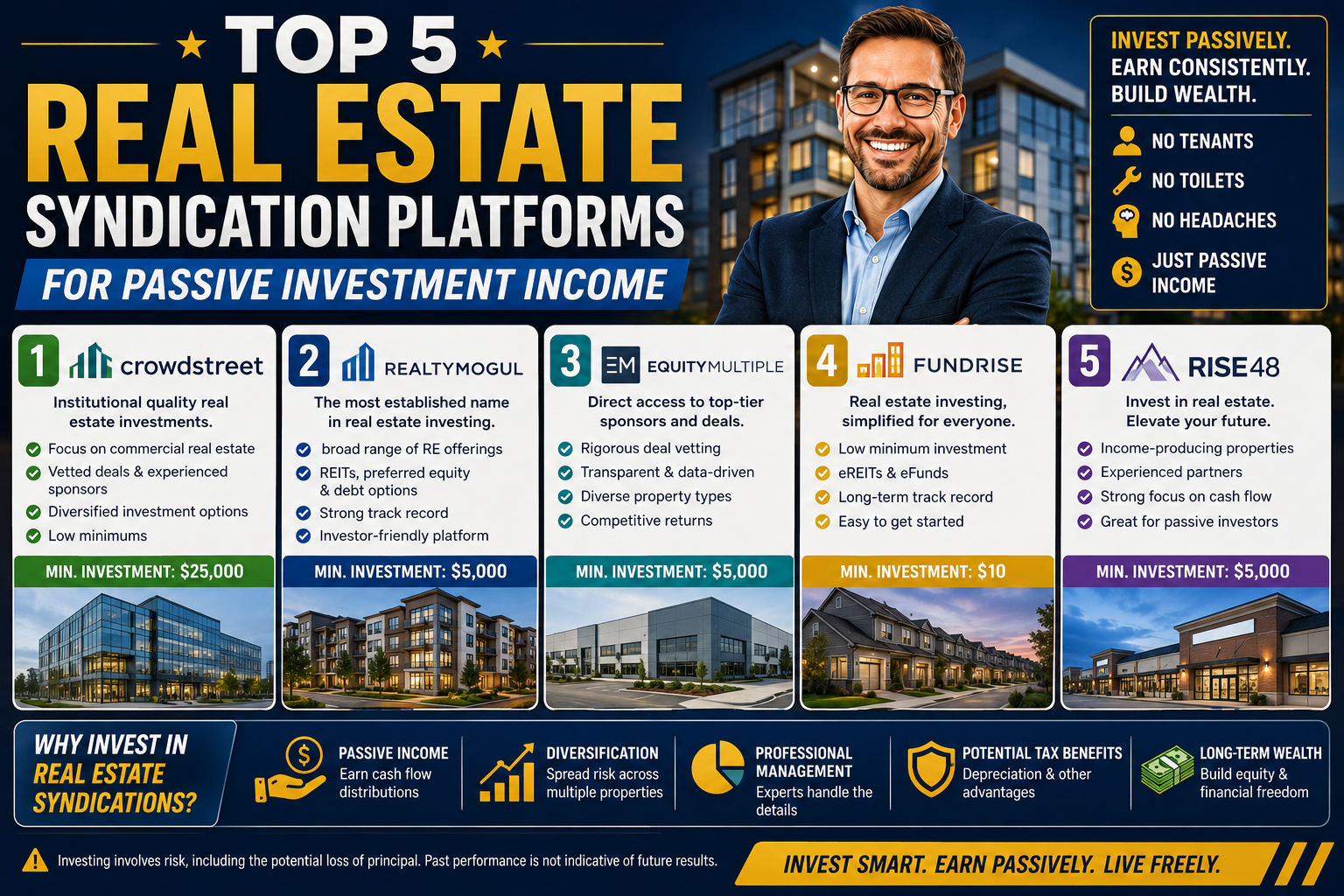
Discover how top-tier real estate syndication platforms allow everyday investors to access institutional-grade commercial properties and build reliable passive income streams.
Table of Contents
Investing in physical real estate has long been hailed as one of the most reliable paths to generational wealth. Yet, buying a multi-family apartment complex or a massive commercial retail center entirely on your own requires millions of dollars in capital, deep market expertise, and a stomach for endless administrative headaches. For decades, these lucrative asset classes were locked behind closed doors, accessible only to ultra-wealthy individuals and institutional funds. That is where modern real estate syndication platforms completely revolutionized the landscape.
By leveraging technology and online crowdfunding regulations, these digital marketplaces pool capital from everyday investors to fund large-scale commercial deals. Instead of acting as an active landlord dealing with middle-of-the-night maintenance calls, you become a passive partner sharing in the cash flow and property appreciation. Choosing the right portal to deploy your capital can feel intimidating with so many options crowding the market. Let us break down the top real estate syndication platforms available today, cutting through the marketing hype to help you find the best fit for your portfolio.
What Is a Real Estate Syndication Platform?
At its core, a syndication is simply a partnership where a group of investors pools their money to acquire a large property that none of them could buy individually. A professional sponsor or operator handles the day-to-day acquisition, management, and eventual sale of the asset, while passive investors contribute capital in exchange for proportional equity and regular cash distributions.
Historically, finding these deals required an exclusive network of wealthy peers and private investment clubs. Today, specialized real estate syndication platforms bring these private equity opportunities straight to your computer screen or mobile device. They handle investor onboarding, legal document signing, asset reporting, and distribution payouts securely online.
- Access to Institutional Assets: Invest in massive multi-family complexes, industrial warehouses, and medical offices with lower capital minimums.
- True Passivity: Enjoy quarterly cash flow distributions and capital gains without ever interacting with a tenant or vendor.
- Transparent Due Diligence: Review detailed business plans, financial projections, and sponsor track records directly inside your dashboard.
Navigating these digital marketplaces opens up an entirely new world of wealth generation, but understanding how individual real estate syndication platforms differ is critical to protecting your capital.
The Top 5 Real Estate Syndication Platforms Compared
Every platform operates with a slightly different business model, catering to unique investor profiles, risk tolerances, and capital minimums. Here are the leading options dominating the industry.
1. CrowdStreet
For accredited investors seeking direct access to institutional-quality commercial real estate deals, CrowdStreet stands out as an industry heavyweight. Rather than pooling your money into a blind fund, CrowdStreet operates as a marketplace where you can browse individual syndication offerings, review detailed sponsor underwriting, and pick specific properties—such as multi-family apartments or industrial logistics parks—that match your goals. Minimum investments typically start around $25,000.
2. RealtyMogul
RealtyMogul offers a versatile hybrid approach, catering to both accredited and non-accredited participants. For everyday investors, the platform provides access to non-traded Real Estate Investment Trusts (REITs) with lower entry barriers. Meanwhile, accredited members can access private placement syndications and 1031 exchange-eligible properties. Their rigorous vetting process and clean user interface make evaluating opportunities straightforward. You can review guidelines on real estate economics to understand how market cycles influence these private offerings.
3. EquityMultiple
If you prefer debt investments alongside traditional equity plays, EquityMultiple is worth a serious look. This platform specializes in commercial real estate syndications with a strong emphasis on short-term debt notes, senior participations, and mezzanine financing. These structures often provide shorter hold periods and predictable, fixed-income yields, making them popular among conservative investors looking to diversify away from pure equity volatility.
4. Fundrise
While technically a pioneer in large-scale real estate crowdfunding via proprietary eREITs rather than direct deal syndication, Fundrise deserves a spot on any passive income list. It allows non-accredited individuals to invest in diversified portfolios of residential and commercial properties with minimums starting as low as $10. It is an ideal entry point for beginners who want exposure to real estate without meeting accredited investor wealth requirements. You can review insights on investment funds to see how diversified pooled vehicles operate.
5. Cadre
Cadre connects high-net-worth individuals and family offices with institutional-grade commercial real estate deals. Backed by prominent venture capital, the platform prides itself on rigorous underwriting and data-driven deal selection. Cadre also offers a secondary market liquidity option for certain offerings, helping alleviate the notoriously illiquid nature of private real estate syndications.
Key Factors to Evaluate Before Investing
Choosing among these real estate syndication platforms requires looking past flashy marketing materials and examining the underlying fundamentals of each deal.
- Sponsor Track Record: The platform is merely the technology bridge; the sponsor is the team executing the business plan. Always review their history through past market downturns.
- Fee Structures: Understand upfront acquisition fees, ongoing asset management fees, and the sponsor’s promoted interest (carried interest) structure.
- Liquidity Constraints: Most syndications lock your capital up for three to seven years. Ensure you will not need those funds unexpectedly during the hold period.
Evaluating these metrics carefully ensures that your chosen real estate syndication platforms align seamlessly with your long-term financial strategy.
FAQs
What is the difference between an accredited and non-accredited investor?
An accredited investor generally has an annual income exceeding $200,000 ($300,000 combined with a spouse) for the last two years or a net worth over $1 million excluding their primary residence. Many traditional real estate syndication platforms require this status, though some portals offer options for non-accredited participants.
How do I make money through real estate syndication platforms?
Investors typically earn returns through two primary channels: regular quarterly or monthly cash flow distributions generated from rental income, and a final lump-sum payout when the underlying property is refinanced or sold at an appreciated value.
Are investments on these platforms liquid?
No. Real estate syndications are highly illiquid alternative investments. Once you fund a deal, your capital remains committed for the duration of the business plan—typically ranging anywhere from three to ten years.
What are the typical minimum investment amounts?
Minimums vary widely depending on the platform and specific offering. While digital retail funds might accept as little as $10 to $1,000, individual commercial property syndications hosted on real estate syndication platforms usually require a minimum investment of $25,000 to $50,000.
Do these platforms own the properties directly?
No. The platform acts as a technology intermediary and marketplace connecting you with third-party operating companies (sponsors) who actually acquire, manage, and execute the business plan for the physical real estate asset.
Conclusion
Building a diversified real estate portfolio no longer requires managing physical properties or possessing millions in personal liquidity. By leveraging digital technology and professional sponsorship, everyday investors can tap into institutional-grade assets that were once completely out of reach. While due diligence is essential, utilizing reputable real estate syndication platforms remains one of the most efficient ways to generate reliable, truly passive cash flow and secure your financial future.
