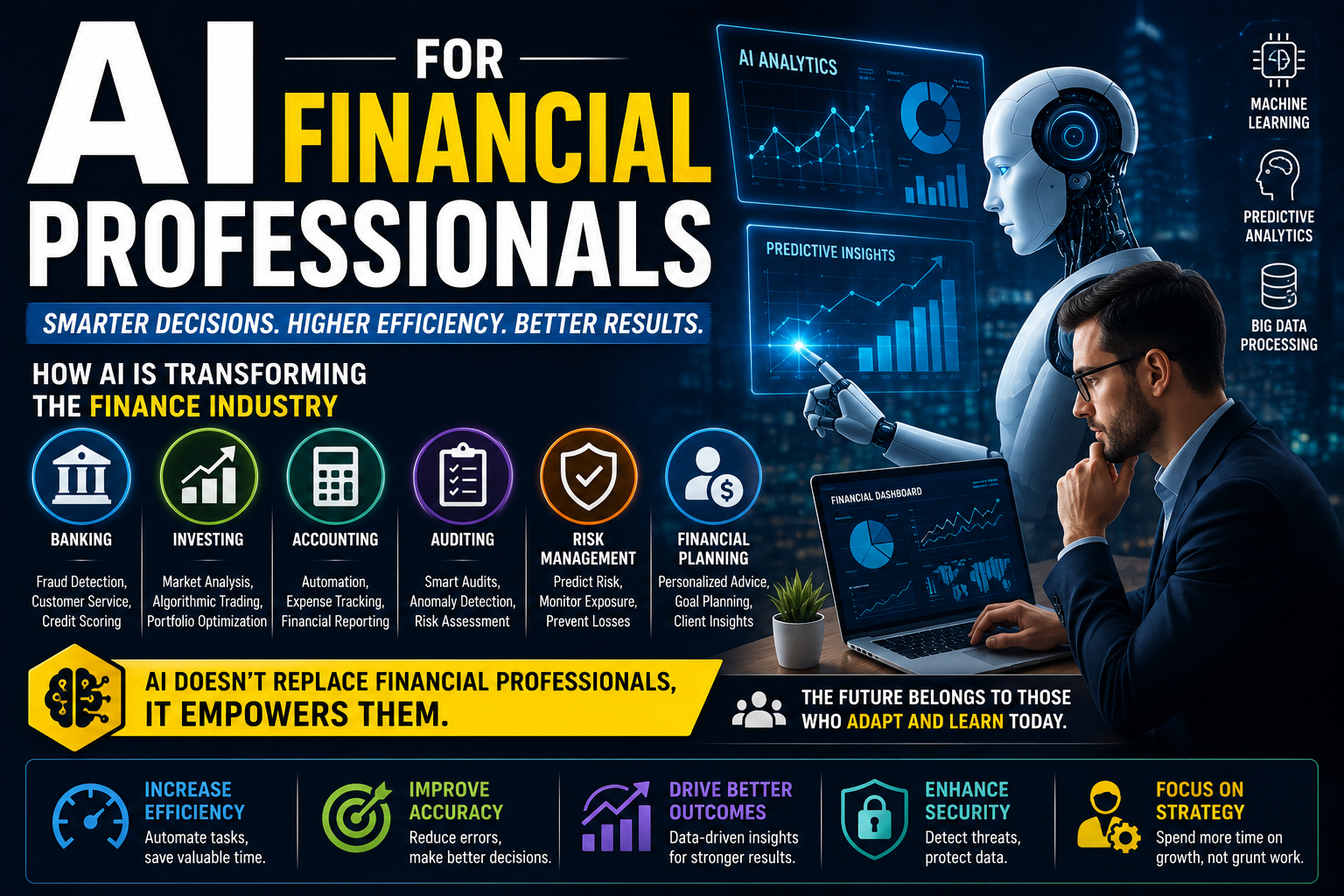
Discover how AI for Financial Professionals is revolutionizing banking, investing, accounting, auditing, risk management, and financial planning. Learn the benefits, challenges, real-world applications, and future of AI in finance.
Table of Contents
Artificial Intelligence (AI) is no longer a futuristic concept reserved for technology companies. It has become one of the most transformative forces in the global financial industry, changing how banks operate, investment firms analyze markets, accountants prepare reports, and financial advisors serve clients.
From fraud detection and automated financial analysis to predictive forecasting and personalized investment recommendations, AI is helping financial professionals make faster, more accurate, and data-driven decisions.
According to industry research, financial institutions invest billions of dollars annually in AI technologies to improve efficiency, reduce operational costs, strengthen cybersecurity, and enhance customer experiences. As AI continues to evolve, professionals who understand how to leverage these technologies will have a significant competitive advantage.
In this guide, we’ll explore how AI for Financial Professionals is reshaping the industry, examine practical use cases, discuss the benefits and limitations of AI, and explain why human expertise remains essential in modern finance.
What Is AI in Finance?
Artificial Intelligence in finance refers to the use of machine learning, natural language processing (NLP), predictive analytics, computer vision, and other AI technologies to automate financial tasks, analyze large datasets, identify patterns, and support decision-making.
Unlike traditional software that follows predefined rules, AI systems can learn from historical data, adapt to changing conditions, and improve their performance over time.
Financial professionals now use AI to analyze millions of transactions, detect fraudulent activities, generate financial forecasts, monitor regulatory compliance, and even assist clients with investment decisions.
To learn more about AI technologies, visit the IBM AI Learning Center:
https://www.ibm.com/topics/artificial-intelligence
Why AI Is Becoming Essential for Financial Professionals
The financial industry generates enormous amounts of data every second.
Banks process millions of transactions.
Investment firms monitor global markets.
Insurance companies assess thousands of claims.
Accounting firms prepare financial reports for countless clients.
Analyzing such massive volumes of information manually is both time-consuming and prone to human error.
AI enables professionals to process this information faster while identifying trends and risks that might otherwise go unnoticed.
Instead of replacing financial professionals, AI is increasingly becoming a powerful decision-support tool.
AI in Banking
Banks were among the earliest adopters of Artificial Intelligence.
Today, AI supports numerous banking functions.
Fraud Detection
AI continuously analyzes customer transactions.
If unusual activity is detected—such as purchases from unfamiliar locations or spending patterns that differ significantly from previous behavior—the system can flag or temporarily block the transaction.
Modern AI fraud detection systems respond within seconds.
Customer Service
Many financial institutions now use AI-powered virtual assistants and chatbots to answer customer questions, process simple requests, and provide account information 24 hours a day.
This reduces waiting times while allowing human representatives to focus on more complex issues.
Credit Risk Assessment
Traditional lending decisions relied heavily on credit scores.
AI models can evaluate a broader range of financial data, helping lenders make faster and potentially more accurate credit decisions.
AI in Investment Management
Investment firms increasingly rely on AI to improve research and portfolio management.
Market Analysis
AI systems analyze:
- Company earnings
- Economic indicators
- Financial statements
- Interest rates
- News articles
- Social media sentiment
- Global events
This enables investors to process information far more quickly than manual research alone.
Algorithmic Trading
Many institutional investors use AI-powered trading systems capable of executing trades within milliseconds.
These algorithms identify market opportunities, monitor risk, and react to changing market conditions in real time.
Portfolio Optimization
AI helps portfolio managers evaluate thousands of possible asset allocations while considering:
- Risk tolerance
- Investment objectives
- Diversification
- Market volatility
This allows for more personalized investment strategies.
Learn more about financial markets through Nasdaq’s educational resources:
AI in Accounting
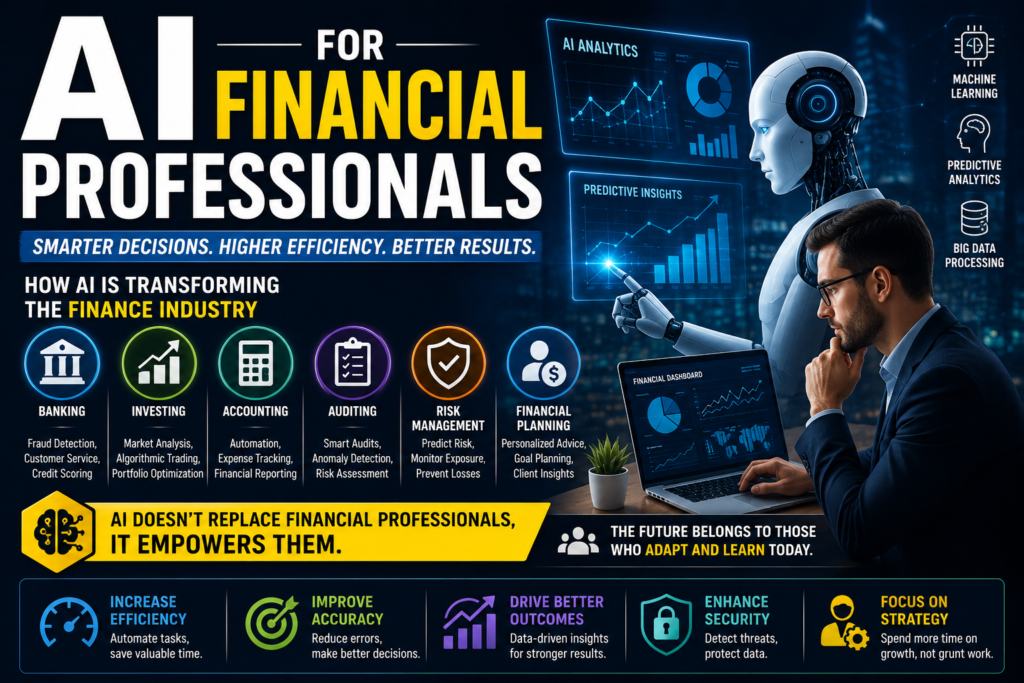
Accounting professionals increasingly use AI to automate repetitive tasks.
Invoice Processing
AI can extract information from invoices automatically, reducing manual data entry.
Expense Categorization
Machine learning systems classify expenses accurately based on historical transactions.
Financial Reporting
AI assists in preparing financial reports by organizing data, identifying inconsistencies, and generating preliminary summaries.
This allows accountants to focus on analysis rather than administrative work.
AI in Auditing
Auditing has traditionally involved manually reviewing financial records.
AI significantly improves this process.
Instead of examining small samples, AI can analyze entire datasets, increasing the likelihood of identifying unusual transactions.
Benefits include:
- Faster audits
- Improved accuracy
- Better fraud detection
- Reduced manual workload
AI in Financial Planning
Financial advisors increasingly use AI-powered tools to support client relationships.
These systems can:
- Analyze spending habits
- Estimate retirement needs
- Forecast investment growth
- Recommend diversified portfolios
- Monitor financial goals
Rather than replacing advisors, AI enables them to provide more personalized guidance.
AI in Risk Management
Managing financial risk has become increasingly complex due to globalization and rapidly changing markets.
AI assists by:
- Identifying emerging risks
- Monitoring market volatility
- Detecting unusual trading behavior
- Evaluating credit exposure
- Forecasting economic scenarios
Large financial institutions use AI to continuously monitor thousands of risk variables simultaneously.
AI for Regulatory Compliance
Financial regulations continue to evolve worldwide.
AI helps compliance teams by:
- Monitoring transactions
- Identifying suspicious activities
- Detecting potential money laundering
- Reviewing regulatory documents
- Flagging unusual customer behavior
This technology, often called RegTech (Regulatory Technology), helps institutions reduce compliance costs while improving accuracy.
Learn more about global financial regulation through the Financial Stability Board (FSB):
Benefits of AI for Financial Professionals
AI offers numerous advantages.
Increased Efficiency
Routine tasks can be completed much faster than manual processes.
Improved Accuracy
Machine learning systems reduce human errors in repetitive tasks.
Better Decision-Making
AI analyzes vast amounts of financial information that would be impossible for individuals to review manually.
Cost Savings
Automation reduces operational expenses and improves productivity.
Enhanced Customer Experience
Clients receive faster responses, personalized recommendations, and improved financial services.
Stronger Fraud Prevention
Real-time monitoring enables financial institutions to identify suspicious activities almost instantly.
Challenges of AI in Finance
Despite its advantages, AI also presents challenges.
Data Privacy
Financial institutions handle highly sensitive customer information.
Protecting this data remains a top priority.
Algorithm Bias
AI models learn from historical data.
Poor-quality or biased data may produce unfair decisions.
Cybersecurity Risks
As AI systems become more sophisticated, cybercriminals also develop increasingly advanced attack methods.
Continuous security improvements remain essential.
Regulatory Uncertainty
Governments worldwide continue developing regulations governing AI use in financial services.
Financial institutions must remain compliant as rules evolve.
Will AI Replace Financial Professionals?
This is one of the most frequently asked questions.
The short answer is:
Unlikely.
AI excels at:
- Processing data
- Automating repetitive work
- Identifying patterns
- Performing calculations
However, financial professionals provide skills that AI cannot fully replicate.
These include:
- Strategic thinking
- Ethical judgment
- Client relationships
- Complex negotiations
- Leadership
- Regulatory interpretation
- Emotional intelligence
Rather than replacing professionals, AI is transforming their roles.
The future belongs to professionals who know how to combine financial expertise with AI-powered tools.
Skills Financial Professionals Should Develop
As AI adoption continues, professionals should strengthen skills such as:
- Financial analysis
- Data interpretation
- AI literacy
- Critical thinking
- Communication
- Cybersecurity awareness
- Regulatory knowledge
- Business strategy
Understanding AI is becoming just as important as understanding spreadsheets.
Common Myths About AI in Finance
Myth 1: AI Will Replace Every Finance Job
False.
AI automates repetitive tasks but still requires human oversight.
Myth 2: AI Never Makes Mistakes
False.
AI depends on data quality and model design.
Human review remains essential.
Myth 3: Only Large Banks Can Use AI
False.
Cloud-based AI solutions have made advanced technologies accessible to startups, accounting firms, and small financial businesses.
Frequently Asked Questions
What is AI for Financial Professionals?
AI for Financial Professionals refers to the use of artificial intelligence technologies to automate financial processes, analyze data, improve decision-making, detect fraud, manage risk, and enhance client services.
Can AI replace accountants?
AI can automate many accounting tasks, but professional judgment, regulatory expertise, and strategic financial advice still require human accountants.
How is AI used in banking?
Banks use AI for fraud detection, customer service, credit risk assessment, regulatory compliance, cybersecurity, and personalized financial services.
Why should financial professionals learn AI?
Professionals who understand AI can improve productivity, make better decisions, adapt to changing technologies, and remain competitive in the evolving financial industry.
Conclusion
The rise of AI for Financial Professionals marks one of the most significant transformations in modern finance. From banking and investment management to accounting, auditing, and regulatory compliance, artificial intelligence is helping professionals process information faster, reduce manual work, improve accuracy, and deliver better outcomes for clients.
However, AI is not replacing financial expertise—it is enhancing it. Human judgment, ethical decision-making, strategic planning, and relationship management remain essential qualities that technology cannot fully replicate. The most successful professionals in the years ahead will be those who embrace AI as a powerful tool while continuing to develop their financial knowledge and critical thinking skills. As artificial intelligence continues to evolve, staying informed and adaptable will become one of the greatest competitive advantages in the global financial industry.
Learn everything about the Credit Utilization Ratio, including how it’s calculated, why it impacts your credit score, what percentage is considered good, and practical tips to improve your credit health.
