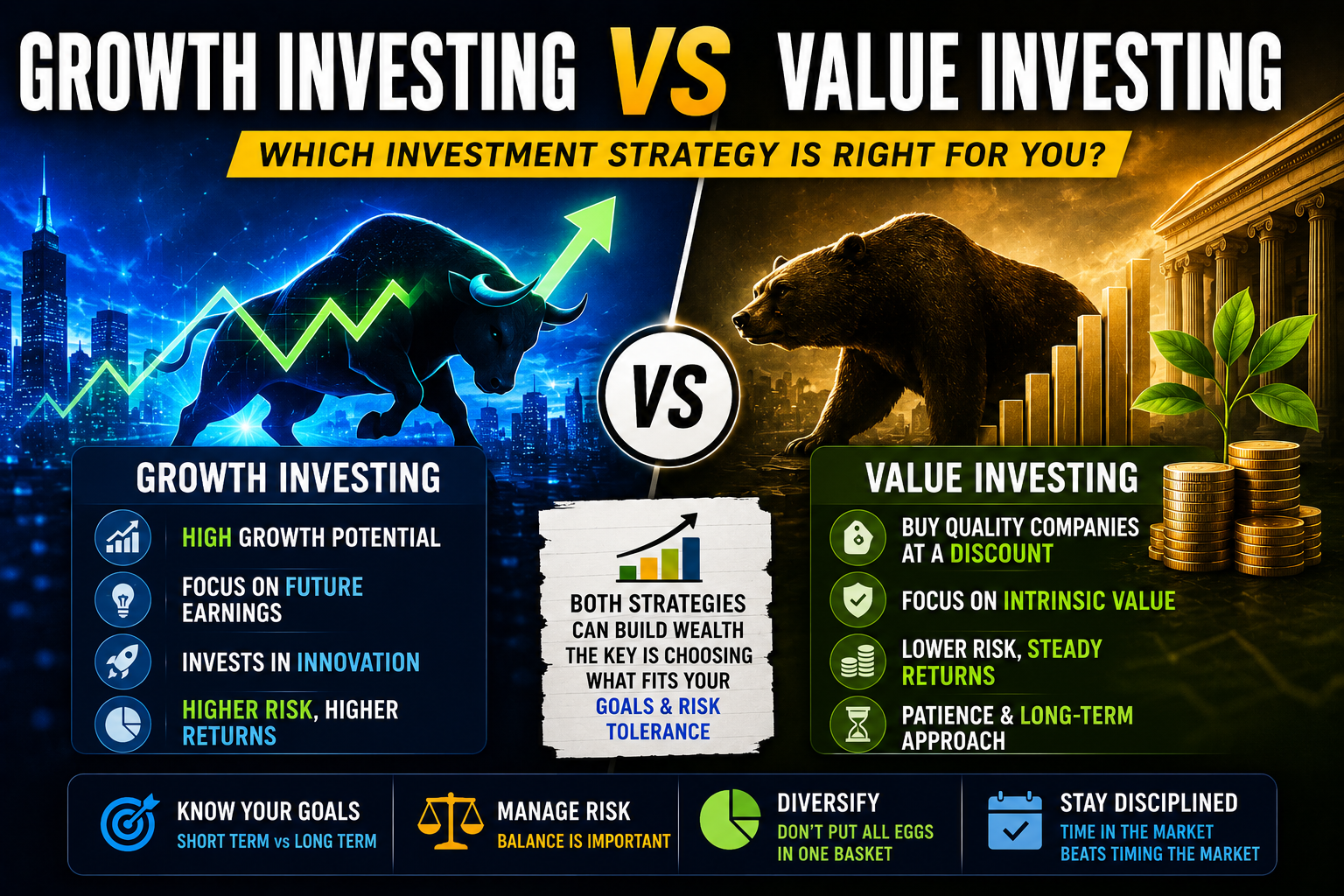
Learn the difference between Growth Investing vs Value Investing, how each strategy works, their advantages, risks, and which investment approach best matches your financial goals.
Table of Contents
Every investor eventually faces one important question: Should you invest in fast-growing companies or buy undervalued businesses with strong fundamentals?
This debate has shaped investment strategies for decades and has influenced some of the world’s most successful investors. While growth investors search for companies expected to deliver exceptional future earnings, value investors look for quality businesses trading below their intrinsic worth.
Both strategies have created billionaires, generated impressive long-term returns, and proven successful across different market cycles. However, they follow very different philosophies and perform differently depending on economic conditions.
If you’re building a long-term investment portfolio, understanding Growth Investing vs Value Investing can help you make better investment decisions and choose a strategy that aligns with your financial goals, risk tolerance, and investment horizon.
In this guide, we’ll explain how both investment styles work, compare their strengths and weaknesses, examine real-world examples, and help you determine which approach may be right for you.
What Is Growth Investing?
Growth investing is an investment strategy that focuses on companies expected to grow their revenue, earnings, and market share at a faster rate than the overall market.
Growth investors are willing to pay higher prices today because they believe these companies will become significantly more valuable in the future.
Instead of looking for “cheap” stocks, growth investors prioritize innovation, competitive advantages, expanding markets, and future earnings potential.
Many of today’s largest companies were once considered growth stocks before becoming mature market leaders.
Learn more about growth investing from Morningstar:
Characteristics of Growth Stocks
Growth companies often share several common characteristics:
- Rapid revenue growth
- High earnings growth expectations
- Significant investment in research and development
- Strong competitive advantages
- Expanding into new markets
- Higher stock valuations
- Limited or no dividend payments
Rather than distributing profits to shareholders, many growth companies reinvest earnings to expand operations and develop new products.
Examples of Growth Companies
Some globally recognized companies have experienced long periods of rapid growth, including:
- NVIDIA
- Amazon
- Tesla
- Shopify
- Netflix
- Adobe
- Salesforce
Many of these companies traded at premium valuations because investors expected substantial future growth.
However, growth stocks can also experience sharp declines if earnings fail to meet expectations.
Advantages of Growth Investing
Growth investing offers several potential benefits.
Higher Return Potential
Successful growth companies can generate exceptional long-term returns as earnings and revenues expand rapidly.
Industry Leadership
Many growth businesses become dominant players in emerging industries such as artificial intelligence, cloud computing, biotechnology, and renewable energy.
Innovation
Growth companies often introduce disruptive technologies that reshape industries and create entirely new markets.
Long-Term Wealth Creation
Investors who identify successful growth businesses early may benefit from significant capital appreciation over time.
Risks of Growth Investing
Despite its appeal, growth investing involves meaningful risks.
Higher Valuations
Growth stocks often trade at expensive price-to-earnings (P/E) ratios because investors expect strong future performance.
Greater Volatility
High-growth companies typically experience larger price swings than mature businesses.
Interest Rate Sensitivity
Growth stocks often perform poorly when interest rates rise because future earnings become less valuable in present-value terms.
High Expectations
Even excellent companies can see their stock prices fall if earnings growth slows below investor expectations.
What Is Value Investing?
Value investing focuses on buying quality companies whose market prices are lower than their intrinsic value.
Instead of chasing rapidly growing businesses, value investors search for companies trading below what they believe the business is actually worth.
The philosophy is simple:
Buy great businesses at attractive prices and hold them until the market recognizes their true value.
This investment approach became famous through legendary investor Warren Buffett, who expanded upon Benjamin Graham’s value investing principles.
You can learn more about value investing through Berkshire Hathaway’s shareholder letters:
Characteristics of Value Stocks
Value stocks often display several common traits:
- Lower Price-to-Earnings (P/E) ratios
- Lower Price-to-Book (P/B) ratios
- Stable earnings
- Strong cash flow
- Regular dividend payments
- Established businesses
- Lower market expectations
These companies may appear “boring,” but many generate consistent profits year after year.
Examples of Value Companies
Examples frequently associated with value investing include mature businesses operating in sectors such as:
- Banking
- Consumer staples
- Energy
- Healthcare
- Insurance
- Industrial manufacturing
Companies like Coca-Cola, Johnson & Johnson, JPMorgan Chase, Procter & Gamble, and Berkshire Hathaway have often been considered value-oriented investments during different periods, although classifications can change as market conditions evolve.
Advantages of Value Investing
Lower Purchase Prices
Buying companies below their estimated intrinsic value provides a potential margin of safety.
Dividend Income
Many value companies return profits through regular dividend payments.
Lower Volatility
Established businesses generally experience smaller price fluctuations than fast-growing technology companies.
Strong Financial Position
Value companies often have proven business models, consistent cash flow, and stable earnings.
Risks of Value Investing
Value investing also carries risks.
Value Traps
Sometimes stocks appear cheap because the underlying business is deteriorating.
Slower Growth
Value companies usually grow more slowly than emerging businesses.
Longer Waiting Period
Markets may take years to recognize a company’s true value.
Changing Industries
Some companies become “cheap” because their industries face long-term structural challenges.
Growth Investing vs Value Investing: Key Differences
| Feature | Growth Investing | Value Investing |
|---|---|---|
| Primary Goal | Capital appreciation | Buy undervalued companies |
| Valuation | Higher | Lower |
| Revenue Growth | High | Moderate |
| Dividend Yield | Usually low | Often higher |
| Risk | Higher | Moderate |
| Volatility | Higher | Lower |
| Investment Horizon | Long-term | Long-term |
| Typical Sectors | Technology, AI, Healthcare | Banking, Energy, Consumer Goods |
Which Strategy Performs Better?
There isn’t a permanent winner.
Growth stocks often outperform during periods of:
- Low interest rates
- Strong economic expansion
- High investor optimism
- Rapid technological innovation
Value stocks often perform better during periods of:
- Rising interest rates
- High inflation
- Economic uncertainty
- Market corrections
Because economic conditions constantly change, leadership frequently shifts between growth and value investing.
Can You Combine Both Strategies?
Absolutely.
Many successful investors diversify across both growth and value stocks instead of choosing only one approach.
For example:
- Growth stocks provide long-term capital appreciation.
- Value stocks offer stability and dividend income.
Combining both styles may reduce portfolio volatility while providing exposure to different market opportunities.
Diversification remains one of the most effective ways to manage investment risk.
The Financial Industry Regulatory Authority (FINRA) provides educational resources on portfolio diversification:
Who Should Consider Growth Investing?
Growth investing may be suitable if you:
- Have a long investment horizon
- Can tolerate higher volatility
- Want maximum capital appreciation
- Believe in technological innovation
- Don’t depend on dividend income
Who Should Consider Value Investing?
Value investing may be appropriate if you:
- Prefer lower investment risk
- Want consistent dividend income
- Focus on long-term stability
- Are comfortable waiting for market recognition
- Prefer established businesses
Common Mistakes Investors Make
Many investors misunderstand the difference between growth and value investing.
Common mistakes include:
- Assuming expensive stocks always make poor investments.
- Buying cheap stocks without understanding why they’re undervalued.
- Ignoring business fundamentals.
- Chasing recent market trends.
- Selling quality companies during short-term volatility.
- Believing only one strategy works forever.
Successful investing often depends more on discipline and patience than on choosing one investment style over another.
Frequently Asked Questions
What is the main difference between Growth Investing vs Value Investing?
Growth investing focuses on companies expected to grow rapidly in the future, while value investing seeks established companies trading below their estimated intrinsic value.
Is Growth Investing riskier than Value Investing?
Generally, yes. Growth stocks often experience greater price volatility because investors have high expectations for future earnings.
Does Warren Buffett follow value investing?
Yes. Warren Buffett is widely recognized as one of the world’s most successful value investors, although he also emphasizes buying high-quality businesses with durable competitive advantages.
Can I invest in both growth and value stocks?
Yes. Many diversified portfolios include both growth and value investments to balance potential returns with risk management.
Conclusion
The debate over Growth Investing vs Value Investing has existed for generations, yet both strategies have consistently rewarded disciplined investors under the right market conditions.
Growth investing focuses on companies with the potential to deliver exceptional future earnings and long-term capital appreciation, while value investing emphasizes purchasing quality businesses at attractive prices with a margin of safety. Neither strategy is universally superior; each performs differently depending on economic conditions, interest rates, and investor sentiment.
Rather than viewing growth and value as competing philosophies, many experienced investors combine both approaches to build balanced portfolios that can adapt to changing markets. By understanding the strengths, risks, and objectives of each strategy, investors can make more informed decisions and develop an investment plan aligned with their financial goals and long-term outlook.
Learn everything about Financial Statements, including the balance sheet, income statement, and cash flow statement. Discover how investors use financial statements to evaluate a company’s financial health before investing.
