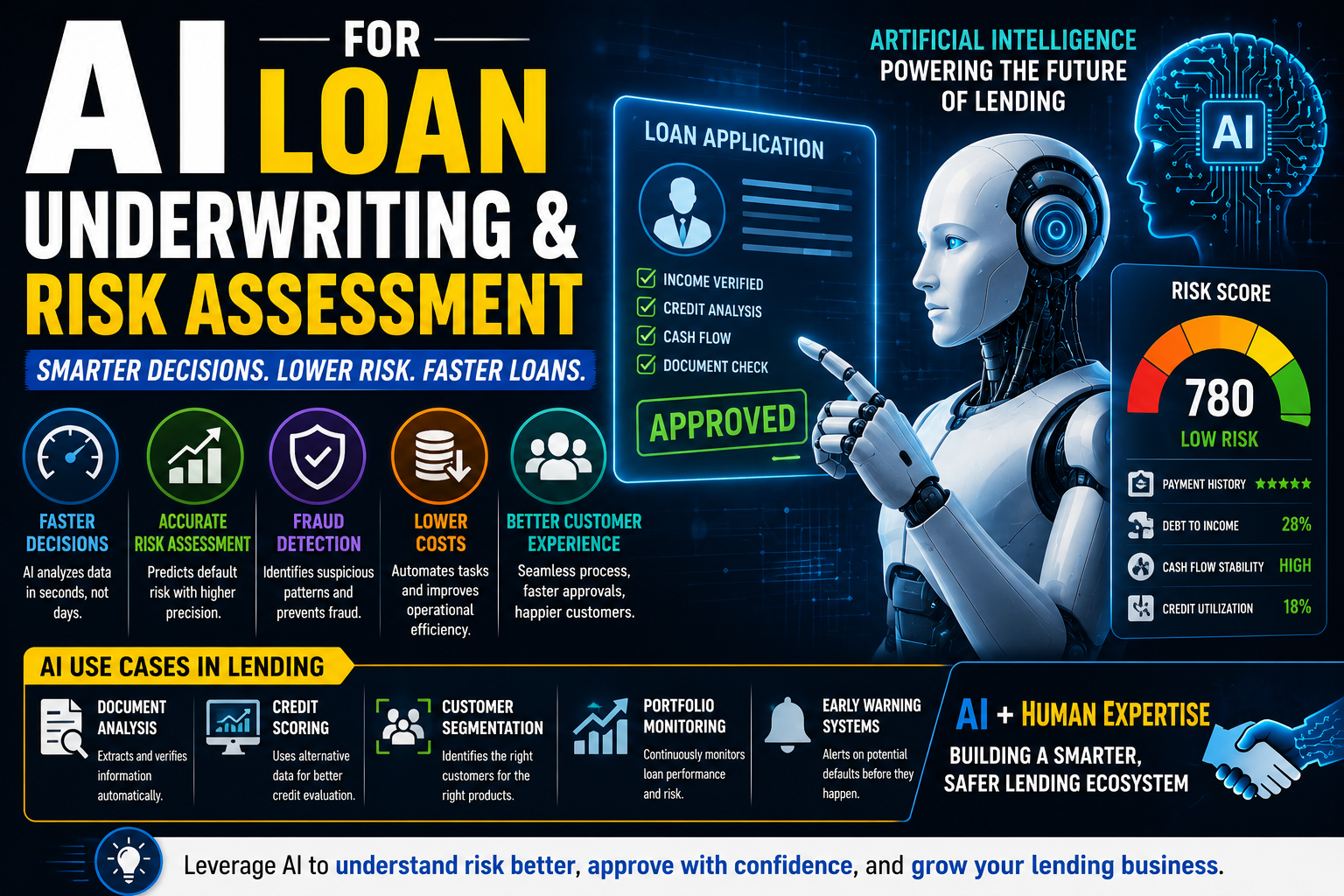
Discover how AI for Loan Underwriting & Risk Assessment is transforming the lending industry. Learn how artificial intelligence improves credit decisions, reduces fraud, speeds up loan approvals, and enhances risk management.
Table of Contents
The lending industry is undergoing one of its biggest transformations in decades, driven by Artificial Intelligence (AI). Traditionally, loan underwriting relied heavily on manual reviews, credit scores, financial statements, and the experience of loan officers. While this approach has worked for years, it is often slow, expensive, and vulnerable to human error.
Today, financial institutions are increasingly adopting AI for Loan Underwriting & Risk Assessment to make lending decisions faster, more accurate, and more efficient. By analyzing vast amounts of financial and behavioral data within seconds, AI enables banks and lenders to assess borrowers with greater precision than traditional methods.
From personal loans and mortgages to business financing and credit cards, AI-powered underwriting systems are helping lenders reduce default risks, detect fraud, improve customer experiences, and expand access to credit.
In this guide, we’ll explore how AI is transforming loan underwriting and risk assessment, its advantages and challenges, real-world applications, and why human expertise remains essential in modern lending.
What Is Loan Underwriting?
Loan underwriting is the process lenders use to determine whether a borrower qualifies for a loan.
During underwriting, financial institutions evaluate the applicant’s ability and willingness to repay the borrowed amount. The goal is to minimize lending risk while making fair and informed credit decisions.
Traditionally, loan underwriters analyze information such as:
- Credit history
- Income
- Employment status
- Existing debts
- Assets
- Financial statements
- Debt-to-income ratio
- Collateral value
Based on this information, lenders decide whether to approve, reject, or modify the loan application.
To learn more about responsible lending practices, visit the Consumer Financial Protection Bureau (CFPB):
https://www.consumerfinance.gov
What Is Risk Assessment in Lending?
Risk assessment is the process of estimating the likelihood that a borrower may fail to repay a loan.
Every loan carries some level of risk. The challenge for lenders is identifying applicants who are likely to repay while avoiding excessive exposure to defaults.
Risk assessment influences several important lending decisions, including:
- Loan approval
- Interest rates
- Credit limits
- Loan terms
- Collateral requirements
Accurate risk assessment benefits both lenders and borrowers by supporting fair pricing and sustainable lending practices.
How Traditional Loan Underwriting Works
For decades, underwriting followed a largely manual process.
Loan officers would collect documents, verify employment, review bank statements, calculate debt ratios, and assess credit reports before making recommendations.
Although effective, this process often involved:
- Long approval times
- Manual document verification
- Human judgment
- Limited data analysis
- Higher operational costs
For large financial institutions processing thousands of applications daily, manual underwriting can become time-consuming and expensive.
What Is AI for Loan Underwriting & Risk Assessment?
AI for Loan Underwriting & Risk Assessment uses technologies such as machine learning, predictive analytics, natural language processing (NLP), and computer vision to automate and enhance lending decisions.
Instead of relying only on traditional credit scores, AI systems analyze a much broader range of financial and behavioral information.
These systems continuously learn from historical lending outcomes, allowing them to improve prediction accuracy over time.
To understand AI technologies in business, visit the IBM AI Learning Center:
https://www.ibm.com/topics/artificial-intelligence
How AI Improves Loan Underwriting
Artificial intelligence can evaluate loan applications within seconds by analyzing thousands of variables simultaneously.
Unlike manual reviews, AI identifies complex relationships in financial data that humans may overlook.
Some of the information AI may evaluate includes:
- Credit history
- Income stability
- Spending behavior
- Banking transactions
- Existing loan obligations
- Business cash flow
- Payment history
- Employment trends
- Industry risk
- Macroeconomic conditions
This enables lenders to make faster and more informed decisions.
AI-Powered Credit Scoring
Traditional credit scoring relies heavily on historical borrowing behavior.
AI expands this approach by incorporating additional data sources that may provide a more complete picture of financial responsibility.
Examples include:
- Banking transaction patterns
- Income consistency
- Business performance
- Cash flow stability
- Utility payment history
- Financial behavior trends
By considering multiple factors, AI can improve credit assessments, particularly for individuals or businesses with limited traditional credit histories.
Faster Loan Approvals
One of the biggest advantages of AI is speed.
Manual underwriting may take several days or even weeks.
AI-powered systems can evaluate applications in minutes—or in some cases, seconds.
This improves customer satisfaction while allowing financial institutions to process more applications with fewer resources.
Digital lenders increasingly offer near-instant approvals using AI-assisted underwriting models.
Fraud Detection
Loan fraud costs financial institutions billions of dollars every year.
AI strengthens fraud prevention by identifying unusual patterns that may indicate fraudulent activity.
Examples include:
- Fake income documents
- Identity theft
- Synthetic identities
- Duplicate loan applications
- Suspicious transaction histories
- Altered financial statements
Machine learning systems continuously improve by learning from previously identified fraud cases.
Risk Prediction
One of AI’s greatest strengths is predictive analytics.
Rather than simply reviewing current financial information, AI estimates the probability of future loan default.
It evaluates patterns across thousands—or even millions—of previous lending decisions to identify risk factors.
This allows lenders to:
- Improve portfolio quality
- Reduce default rates
- Adjust lending strategies
- Optimize interest rate pricing
AI in Mortgage Underwriting
Mortgage lending involves extensive financial documentation.
AI helps automate tasks such as:
- Income verification
- Property document analysis
- Credit evaluation
- Fraud detection
- Employment verification
This reduces paperwork while accelerating mortgage approvals.
AI in Business Lending
Business loans often require evaluating financial statements, tax records, cash flow reports, and operational performance.
AI assists by analyzing:
- Revenue trends
- Profit margins
- Operating expenses
- Industry conditions
- Customer concentration
- Cash flow projections
This enables more comprehensive business risk assessments.
Benefits of AI for Loan Underwriting & Risk Assessment
AI provides significant advantages for lenders and borrowers alike.
Faster Decision-Making
Applications can be reviewed much more quickly than traditional manual processes.
Improved Accuracy
AI minimizes calculation errors and applies consistent evaluation criteria.
Better Risk Management
Machine learning identifies hidden risk patterns that traditional models may overlook.
Lower Operating Costs
Automation reduces manual workloads, improving efficiency and reducing administrative expenses.
Enhanced Fraud Prevention
Real-time monitoring strengthens security and reduces financial losses.
Better Customer Experience
Faster approvals and streamlined processes improve borrower satisfaction.
Challenges of AI in Lending
Although AI offers substantial benefits, several challenges remain.
Data Quality
AI models are only as reliable as the data used to train them.
Incomplete or inaccurate data can produce poor lending decisions.
Algorithm Bias
If historical lending data contains bias, AI systems may unintentionally reproduce unfair outcomes.
Financial institutions must regularly evaluate AI models to ensure fairness and compliance.
Regulatory Compliance
Governments continue developing regulations governing AI in financial services.
Lenders must ensure AI-assisted decisions comply with applicable laws and consumer protection requirements.
Learn more through the Financial Stability Board (FSB):
Cybersecurity
As financial institutions rely more heavily on AI, protecting sensitive customer information becomes increasingly important.
Strong cybersecurity measures remain essential.
Will AI Replace Human Underwriters?
Probably not.
Instead, AI is transforming the role of loan underwriters.
AI excels at:
- Processing large datasets
- Identifying patterns
- Automating repetitive tasks
- Generating risk scores
Human professionals remain essential for:
- Complex lending cases
- Commercial financing
- Regulatory compliance
- Ethical judgment
- Relationship management
- Exception handling
The future is likely to involve collaboration between AI systems and experienced lending professionals rather than complete automation.
Skills Financial Professionals Should Develop
As AI adoption continues, lending professionals should strengthen skills such as:
- Financial analysis
- Credit risk evaluation
- AI literacy
- Data interpretation
- Regulatory compliance
- Critical thinking
- Customer relationship management
Professionals who combine financial expertise with AI capabilities will be well positioned for future opportunities.
Common Myths About AI in Loan Underwriting
Myth 1: AI Approves Every Loan Automatically
False.
AI supports decision-making, but lenders often maintain human oversight, particularly for complex or high-value loans.
Myth 2: AI Eliminates All Lending Risk
False.
No model can predict borrower behavior with complete certainty.
Unexpected economic events can still affect repayment outcomes.
Myth 3: AI Makes Lending Unfair
Not necessarily.
When properly designed and monitored, AI can improve consistency and reduce certain forms of human error.
However, institutions must actively monitor models to minimize bias and ensure responsible lending practices.
Frequently Asked Questions
What is AI for Loan Underwriting & Risk Assessment?
It refers to the use of artificial intelligence to automate loan evaluations, assess borrower risk, detect fraud, and improve lending decisions.
How does AI improve loan approvals?
AI analyzes financial information rapidly, reducing processing time while improving consistency and accuracy.
Can AI replace loan underwriters?
AI automates repetitive tasks, but human expertise remains important for complex lending decisions, compliance, and customer relationships.
Is AI more accurate than traditional underwriting?
AI can improve prediction accuracy by analyzing larger datasets and identifying patterns that manual reviews may overlook. However, model quality depends on accurate data and proper oversight.
Conclusion
The adoption of AI for Loan Underwriting & Risk Assessment is reshaping the global lending industry by making credit decisions faster, more accurate, and more data-driven. From fraud detection and automated document analysis to predictive risk modeling and personalized lending decisions, artificial intelligence is helping financial institutions improve operational efficiency while enhancing the borrower experience.
Despite these advancements, AI is not replacing human expertise. Successful lending still depends on professional judgment, ethical decision-making, regulatory compliance, and strong customer relationships. As financial institutions continue integrating AI into their underwriting processes, professionals who understand both finance and artificial intelligence will play a critical role in building safer, smarter, and more inclusive lending systems for the future.
Discover how AI for Financial Professionals is revolutionizing banking, investing, accounting, auditing, risk management, and financial planning. Learn the benefits, challenges, real-world applications, and future of AI in finance.
