Meta Description:
Learn everything about Loan Prepayment Penalties, including how they work, why lenders charge them, different types of penalties, and how to avoid unexpected loan repayment costs.
Table of Contents
When taking out a loan, most borrowers focus on the interest rate, monthly payments, and repayment period. However, one important clause that many people overlook is the Loan Prepayment Penalty.
Imagine receiving a work bonus, inheritance, or higher income that allows you to repay your loan years ahead of schedule. You expect to save thousands in interest, only to discover your lender charges a fee for paying the loan off early.
This fee is known as a Loan Prepayment Penalty.
Although not every loan includes this clause, prepayment penalties can significantly affect the true cost of borrowing. Understanding how these penalties work helps borrowers make informed financial decisions, compare loan offers accurately, and avoid unexpected charges.
In this guide, we’ll explain what loan prepayment penalties are, why lenders charge them, the different types of penalties, their advantages and disadvantages, and practical tips to avoid them.
What Are Loan Prepayment Penalties?
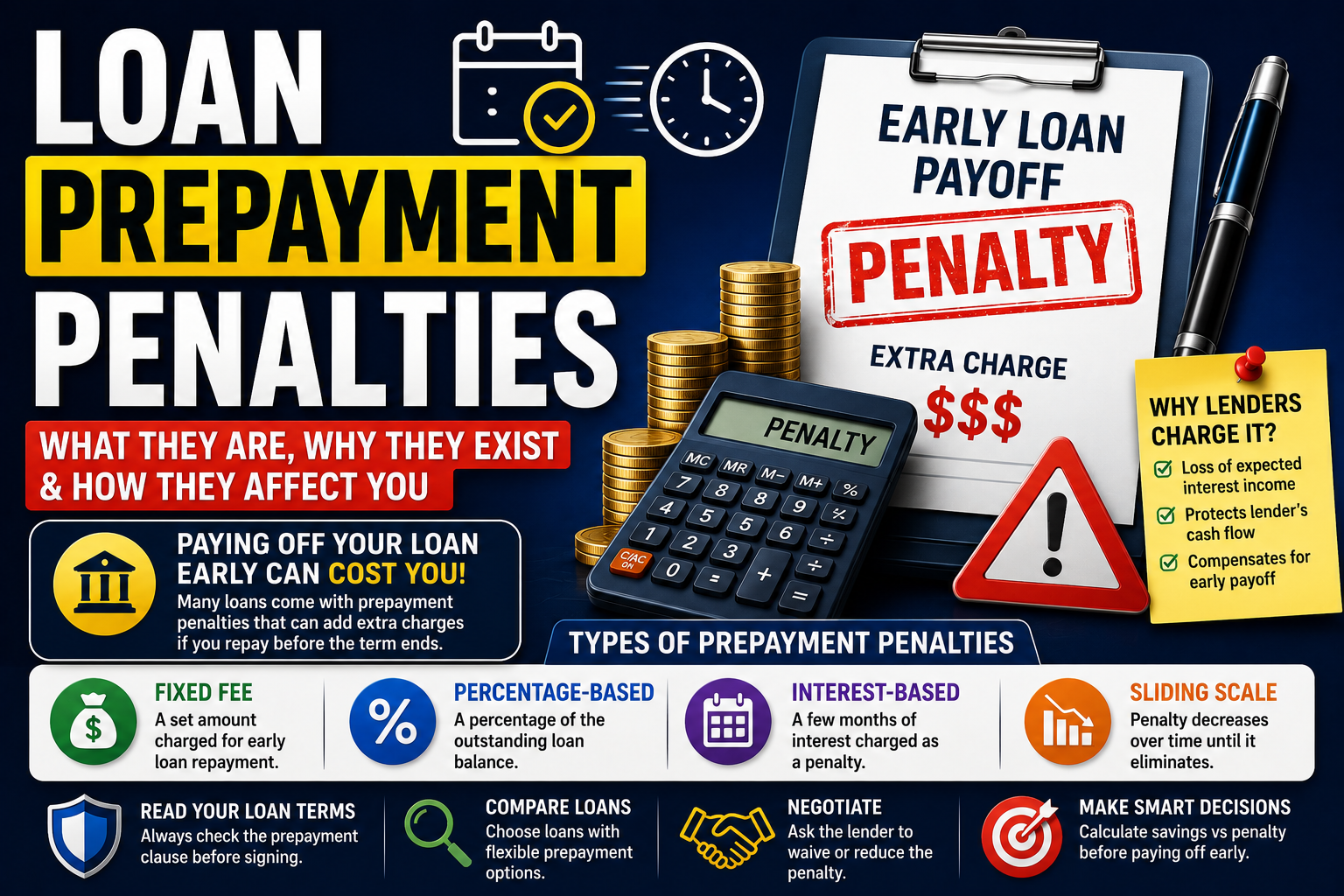
A Loan Prepayment Penalty is a fee charged by some lenders when a borrower repays all or part of a loan before the agreed repayment schedule ends.
The penalty compensates the lender for the interest income they lose when a loan is paid off earlier than expected.
For example, suppose you borrow $200,000 with a 20-year repayment term. If you repay the entire loan after only five years, the lender loses years of expected interest payments. Some loan agreements allow lenders to recover part of this lost income through a prepayment penalty.
Not every loan includes these penalties, and the rules vary depending on the lender, loan type, and local regulations.
To learn more about consumer lending practices, visit the Consumer Financial Protection Bureau (CFPB):
https://www.consumerfinance.gov
Why Do Lenders Charge Prepayment Penalties?
Lenders generate revenue primarily through interest.
When borrowers repay loans earlier than expected, lenders receive less interest than originally projected.
Prepayment penalties help lenders:
- Recover lost interest income
- Improve financial planning
- Reduce refinancing risk
- Maintain predictable cash flows
- Offset administrative costs
While borrowers may see early repayment as financially responsible, lenders may view it as reduced expected earnings.
How Do Loan Prepayment Penalties Work?
The exact calculation depends on the loan agreement.
Some lenders charge:
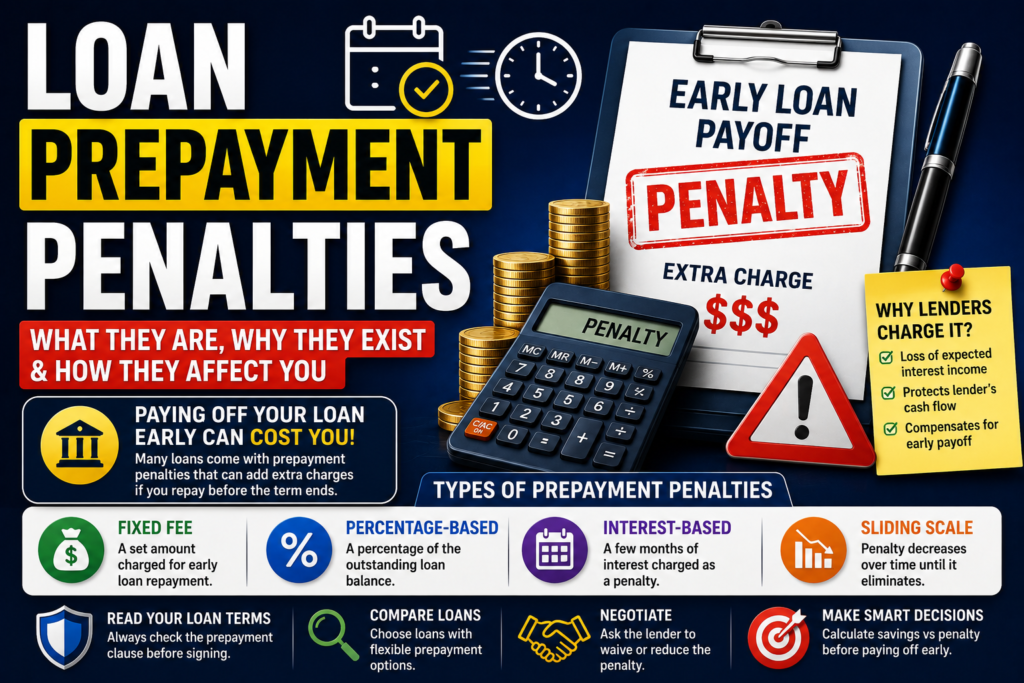
- A fixed fee
- A percentage of the remaining balance
- Several months of interest
- A declining penalty based on how long the loan has been active
For example:
Outstanding Loan Balance: $100,000
Prepayment Penalty: 2%
Penalty Amount:
$100,000 × 2% = $2,000
Even if early repayment saves thousands in future interest, borrowers should compare those savings with the penalty before making a decision.
Types of Loan Prepayment Penalties
Different lenders use different penalty structures.
Fixed Fee Penalty
The borrower pays a predetermined amount regardless of the remaining balance.
Example:
Early repayment fee:
$1,000
This method is simple and easy to understand.
Percentage-Based Penalty
The lender charges a percentage of the outstanding loan balance.
Example:
Remaining Balance:
$80,000
Penalty:
3%
Fee:
$2,400
This is one of the most common approaches.
Interest-Based Penalty
Instead of charging a percentage, some lenders require borrowers to pay several months of interest.
Example:
Six months of interest payments.
The exact amount depends on the loan balance and interest rate.
Sliding Scale Penalty
Many lenders reduce the penalty over time.
Example:
Year 1:
5%
Year 2:
4%
Year 3:
3%
Year 4:
2%
Year 5:
1%
After Year 5:
No penalty.
This encourages borrowers to maintain loans for a minimum period while providing greater flexibility later.
Which Loans May Include Prepayment Penalties?
Depending on local laws and lender policies, prepayment penalties may appear in:
- Mortgages
- Commercial loans
- Business loans
- Personal loans
- Auto loans
- Equipment financing
- Investment property loans
However, not every loan includes them.
Many modern lending products no longer charge prepayment penalties, especially in highly competitive markets.
Advantages of Loan Prepayment Penalties
Although borrowers generally dislike these fees, lenders argue they provide several benefits.
Lower Interest Rates
Some lenders offer lower interest rates in exchange for accepting a prepayment penalty clause.
Borrowers who expect to keep the loan for its full term may benefit.
Stable Lending Environment
Predictable loan durations improve financial planning for lending institutions.
Lower Initial Costs
In some cases, lenders may reduce origination fees or offer better loan terms because of the added protection provided by the penalty.
Disadvantages for Borrowers
For many borrowers, prepayment penalties create financial challenges.
Reduced Flexibility
Borrowers may delay paying off debt because of additional costs.
Higher Overall Costs
Unexpected penalties can reduce the financial benefit of early repayment.
Refinancing Becomes More Expensive
Borrowers seeking lower interest rates elsewhere may hesitate if a large prepayment penalty applies.
More Complex Loan Comparisons
A loan with a lower interest rate may not always be cheaper once penalties are considered.
Should You Pay Off a Loan Early?
The answer depends on your specific situation.
Ask yourself:
- How much interest will I save?
- How large is the prepayment penalty?
- Could the money earn a better return elsewhere?
- Do I need additional financial flexibility?
- Will early repayment improve my financial goals?
Sometimes paying the penalty still results in substantial long-term savings.
Other times, keeping the loan may be the better financial decision.
How to Avoid Loan Prepayment Penalties
Fortunately, borrowers have several options.
Read the Loan Agreement Carefully
Always review the section discussing:
- Prepayment
- Early repayment
- Loan payoff
- Additional fees
Never assume early repayment is free.
Ask Questions Before Signing
Ask the lender:
- Does this loan include a prepayment penalty?
- How is it calculated?
- When does the penalty expire?
- Can I make partial prepayments without charges?
Understanding these details can prevent costly surprises.
Compare Multiple Lenders
Many financial institutions now offer loans without prepayment penalties.
Comparing several loan offers helps identify more borrower-friendly terms.
Negotiate
For larger loans, especially business financing, lenders may agree to reduce or remove prepayment penalties during negotiations.
Loan Prepayment Penalties vs Loan Origination Fees
These two charges are often confused.
Loan Origination Fee:
Charged when the loan is issued.
Loan Prepayment Penalty:
Charged when the loan is repaid early.
They serve completely different purposes.
Common Myths About Loan Prepayment Penalties
Myth 1: Every Loan Has a Prepayment Penalty
False.
Many loans have no early repayment charges.
Myth 2: Paying Off a Loan Early Always Saves Money
Not necessarily.
Borrowers should compare interest savings with any applicable penalties.
Myth 3: Prepayment Penalties Last Forever
False.
Many penalties expire after a specified number of years.
Frequently Asked Questions
What are Loan Prepayment Penalties?
Loan prepayment penalties are fees some lenders charge when borrowers repay loans earlier than agreed in the loan contract.
Why do lenders charge prepayment penalties?
They help compensate lenders for interest income lost when loans are repaid ahead of schedule.
Are prepayment penalties legal?
Yes, in many jurisdictions, although regulations vary depending on the country and loan type. Some loans may prohibit or limit these penalties.
Can I avoid paying a prepayment penalty?
Often, yes. Borrowers can compare lenders, negotiate loan terms, or choose financing products that do not include prepayment penalties.
Conclusion
Understanding Loan Prepayment Penalties is an important part of making informed borrowing decisions. While paying off debt early often reduces interest costs and improves financial freedom, some loan agreements include penalties that can reduce or even eliminate those savings. For this reason, borrowers should look beyond interest rates and carefully review all loan terms before signing an agreement.
The best approach is to compare multiple lenders, ask clear questions about early repayment policies, and calculate whether paying off a loan early truly provides a financial advantage after considering any applicable fees. By understanding how loan prepayment penalties work, borrowers can avoid costly surprises, choose financing that aligns with their long-term goals, and manage debt more effectively.
Learn how long late payments stay on a credit report, how they affect your credit score, and practical strategies to rebuild your credit history after missed payments.
