Meta Description:
Learn everything about Currency Exchange Fees, including how they work, hidden costs, exchange rate markups, ATM charges, foreign transaction fees, and practical ways to save money when exchanging currencies internationally.
Table of Contents
Traveling abroad, shopping from international websites, sending money overseas, or investing in foreign assets has become easier than ever. However, many people are surprised when they discover that the amount they actually receive after converting money is significantly lower than expected.
The reason is often Currency Exchange Fees.
While most people focus only on the displayed exchange rate, the true cost of currency conversion can include hidden markups, foreign transaction fees, ATM charges, service fees, and payment network costs. Even small differences in exchange rates can add up to hundreds or even thousands of dollars over time, especially for frequent travelers, international businesses, digital nomads, and global investors.
Understanding how currency exchange fees work can help you avoid unnecessary costs and ensure you receive better value when converting money.
In this guide, we’ll explain what Currency Exchange Fees are, how they work, the different types of charges you may encounter, common mistakes people make, and practical strategies to reduce your currency conversion costs.
What Are Currency Exchange Fees?
Currency Exchange Fees are charges imposed when one currency is converted into another.
These fees may be charged by:
- Banks
- Currency exchange providers
- Credit card companies
- Payment processors
- ATM operators
- Money transfer services
- Online payment platforms
Sometimes the fee appears as a separate charge.
In many cases, however, the cost is hidden inside the exchange rate itself through a markup.
Understanding both explicit and hidden fees is essential before exchanging money.
To learn more about international payments and financial systems, visit the Bank for International Settlements (BIS):
Why Do Currency Exchange Fees Exist?
Currency exchange providers earn revenue by facilitating foreign exchange transactions.
Their costs include:
- Market risk
- Currency volatility
- Payment network expenses
- Operational costs
- Liquidity management
- Regulatory compliance
Instead of offering the exact market exchange rate, providers typically add a small margin to cover these costs and generate profit.
Understanding the Mid-Market Exchange Rate
The mid-market exchange rate (sometimes called the interbank rate) is the exchange rate at which major financial institutions trade currencies with one another.
This rate is commonly displayed on financial platforms and currency data providers.
However, consumers rarely receive this exact rate.
Instead, banks and exchange providers usually apply a markup.
You can monitor global exchange rates through XE Currency:
Hidden Exchange Rate Markups
Many people assume “zero commission” means exchanging money is free.
Unfortunately, this isn’t always true.
Instead of charging a visible fee, providers may offer an exchange rate that is less favorable than the current market rate.
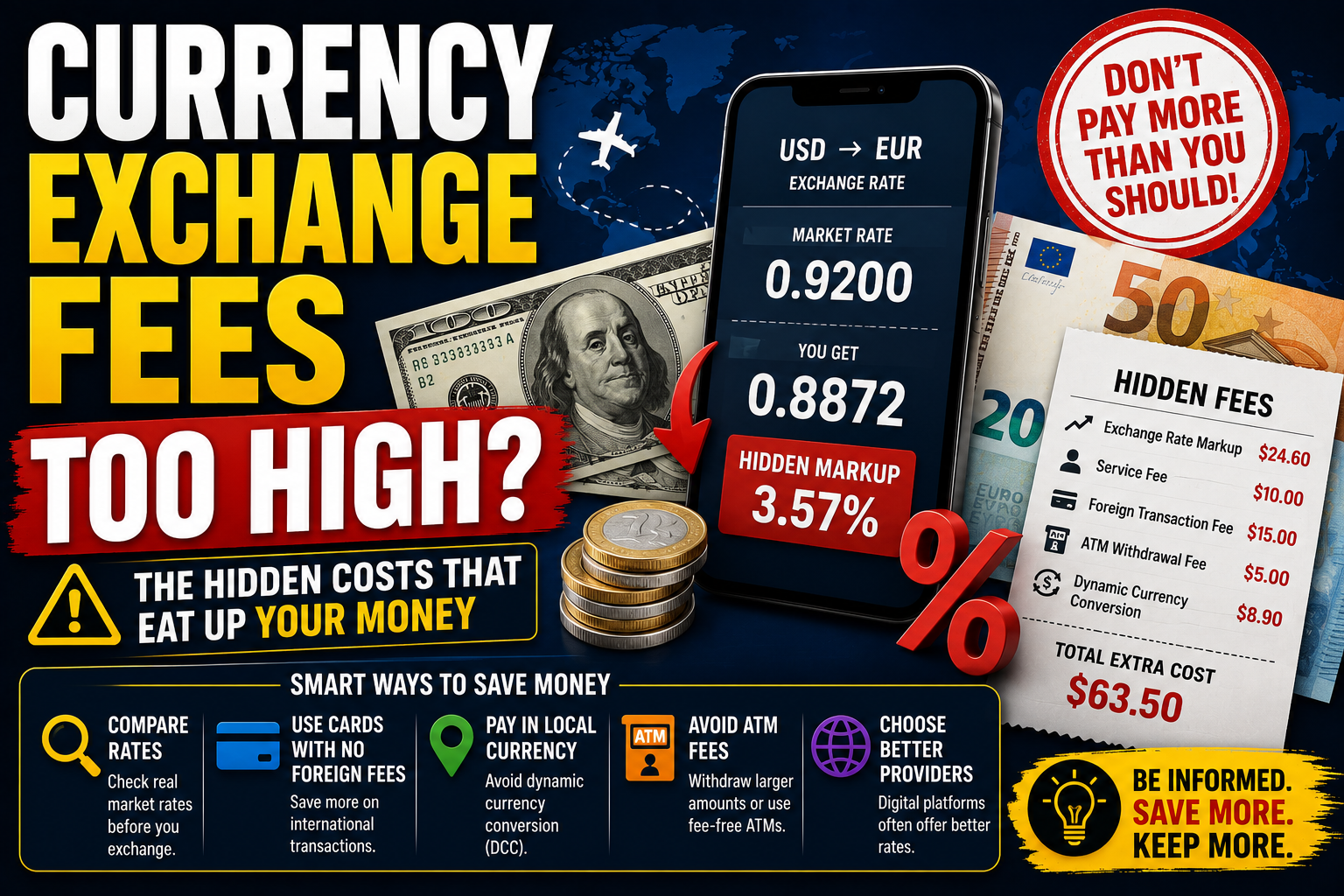
For example:
Mid-market rate:
1 USD = 0.92 EUR
Exchange provider offers:
1 USD = 0.89 EUR
The difference represents an exchange rate markup.
Although no separate fee appears on the receipt, you’re effectively paying for the conversion through the less favorable rate.
Types of Currency Exchange Fees
Understanding the different charges helps you compare providers more accurately.
Exchange Rate Markup
This is the most common hidden cost.
The provider offers an exchange rate slightly worse than the actual market rate.
Even small differences become significant when exchanging larger amounts.
Fixed Service Fee
Some providers charge a flat fee regardless of the transaction size.
For example:
Currency exchange fee:
$10
Whether you exchange $100 or $5,000, the fee remains the same.
Percentage-Based Fee
Instead of a fixed charge, some providers deduct a percentage of the transaction amount.
Example:
Exchange amount:
$2,000
Fee:
2%
Total fee:
$40
Foreign Transaction Fee
Many banks and credit card issuers charge an additional fee for purchases made in foreign currencies.
These fees typically range between 1% and 3% of the transaction value, depending on the card issuer.
Before traveling, review your card’s terms and conditions to understand any applicable charges.
Learn more about payment card security and consumer information through Visa:
ATM Withdrawal Fees
Using an ATM abroad may involve several separate charges:
- Your bank’s ATM fee
- Foreign ATM operator fee
- Currency conversion fee
- Foreign transaction fee
These combined costs can make international ATM withdrawals more expensive than expected.
Dynamic Currency Conversion (DCC)
Some merchants offer to charge your purchase in your home currency instead of the local currency.
Although this may seem convenient, Dynamic Currency Conversion often uses less favorable exchange rates than those provided by your card issuer.
Whenever possible, many travelers prefer paying in the local currency, allowing their bank or card network to perform the conversion.
How Currency Exchange Fees Affect Travelers
International travelers frequently encounter exchange fees through:
- Hotel payments
- Restaurant bills
- Shopping
- Taxi services
- ATM withdrawals
- Car rentals
Small fees on individual transactions may seem insignificant, but they can accumulate quickly during longer trips.
Currency Exchange Fees for Online Shopping
Cross-border e-commerce has grown rapidly.
When shopping from international retailers, consumers may encounter:
- Currency conversion fees
- Foreign transaction fees
- Payment processor charges
- Dynamic currency conversion
Always review the final payment amount before confirming international purchases.
Currency Exchange Fees for Businesses
Businesses involved in international trade often exchange large amounts of currency.
Common foreign exchange costs include:
- Import payments
- Export settlements
- Supplier payments
- Payroll for international employees
- Cross-border investments
Even minor exchange rate differences can significantly affect business profitability.
Organizations managing global operations often use specialized foreign exchange providers to reduce costs.
The International Monetary Fund (IMF) provides information on global currency markets:
How to Reduce Currency Exchange Fees
Fortunately, there are several practical ways to lower your currency conversion costs.
Compare Exchange Rates
Never assume every provider offers the same rate.
Compare:
- Banks
- Online currency services
- Currency exchange offices
- Digital payment providers
Even small improvements in exchange rates can produce meaningful savings.
Avoid Airport Currency Exchanges
Airport exchange counters often charge higher markups because of convenience and limited competition.
Whenever possible, compare alternatives before traveling.
Use Credit Cards With No Foreign Transaction Fees
Some credit cards waive foreign transaction fees entirely.
Review your card’s benefits before making international purchases.
Pay in the Local Currency
If offered a choice between paying in your home currency or the local currency, many financial experts recommend selecting the local currency to avoid unfavorable Dynamic Currency Conversion rates.
Limit ATM Withdrawals
Instead of making multiple small withdrawals, fewer larger withdrawals may reduce repeated ATM fees.
However, avoid carrying excessive amounts of cash for security reasons.
Common Mistakes People Make
Many consumers unknowingly pay higher exchange costs because they:
- Accept the first exchange rate offered.
- Use airport exchange counters without comparing prices.
- Ignore exchange rate markups.
- Accept Dynamic Currency Conversion automatically.
- Fail to review foreign transaction fees on their credit cards.
- Withdraw small amounts repeatedly from international ATMs.
Being aware of these habits can help reduce unnecessary expenses.
Are Currency Exchange Fees Tax-Deductible?
For individuals, currency exchange fees are generally considered personal expenses and are typically not tax-deductible.
For businesses, however, foreign exchange costs may sometimes be treated as business expenses depending on the jurisdiction and the purpose of the transaction.
Because tax rules vary by country, businesses should consult qualified tax professionals before making deductions.
Frequently Asked Questions
What are Currency Exchange Fees?
Currency Exchange Fees are costs associated with converting one currency into another. They may include exchange rate markups, service charges, foreign transaction fees, ATM fees, and payment processing costs.
Why is my exchange rate different from the one shown online?
Many websites display the mid-market exchange rate, while banks and exchange providers typically apply their own markup or service fee.
Is Dynamic Currency Conversion a good option?
In many cases, paying in the local currency provides a better exchange rate than accepting Dynamic Currency Conversion, although individual circumstances may vary.
How can I reduce Currency Exchange Fees?
Comparing providers, using cards with no foreign transaction fees, avoiding airport exchanges, paying in local currency, and reviewing exchange rates before converting money can all help reduce costs.
Conclusion
Understanding Currency Exchange Fees is essential for anyone who travels internationally, shops across borders, sends money overseas, or manages global business transactions. While exchange rates often receive the most attention, the true cost of currency conversion frequently includes hidden markups, service charges, ATM fees, and foreign transaction fees that can significantly increase the overall expense.
By comparing exchange providers, avoiding unnecessary dynamic currency conversion, using payment methods with lower international fees, and staying informed about current market exchange rates, consumers and businesses can make smarter financial decisions and reduce unnecessary costs. In an increasingly connected global economy, understanding how currency exchange fees work is an important step toward protecting your money and maximizing the value of every international transaction.
Learn what to do if an ATM dispensed no cash but debited your account. Discover why ATM cash withdrawal failures happen, how refunds work, common causes, and the steps to recover your money quickly
