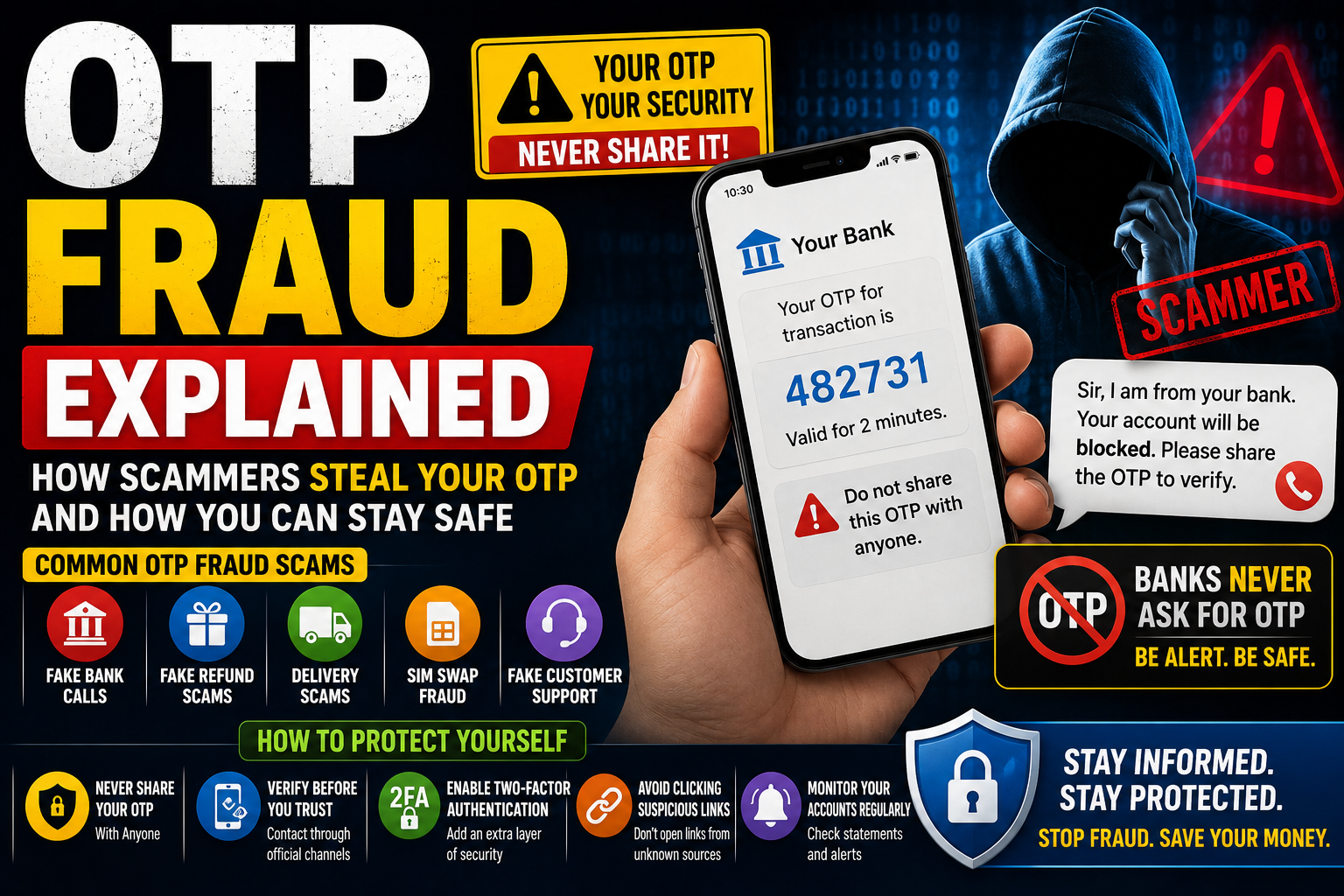
Learn everything about OTP Fraud, including how scammers steal One-Time Passwords, common fraud techniques, warning signs, and practical tips to protect your bank accounts and online payments.
Table of Contents
Online banking and digital payments have made managing money easier than ever. Whether you’re shopping online, transferring money, logging into your bank account, or verifying a payment, you’ve probably received a One-Time Password (OTP) on your phone or email.
OTPs are designed to add an extra layer of security by ensuring that only the authorized user can complete a transaction. However, cybercriminals have found ways to manipulate people into revealing these codes, turning a security feature into a powerful tool for financial fraud.
OTP Fraud has become one of the most common forms of cybercrime worldwide. Every year, thousands of individuals lose money because they unknowingly share their OTPs with scammers posing as bank officials, customer support agents, delivery executives, or even government representatives.
The good news is that OTP fraud is highly preventable. By understanding how these scams work and recognizing the warning signs, you can significantly reduce your risk of becoming a victim.
In this guide, we’ll explain what OTP Fraud is, how scammers operate, common fraud techniques, real-life examples, and the best practices to protect your financial information.
What Is OTP Fraud?
OTP Fraud is a type of financial scam in which criminals trick individuals into revealing their One-Time Password (OTP). Once they obtain the OTP, scammers use it to complete unauthorized transactions, access online accounts, or steal sensitive financial information.
An OTP is a temporary security code generated by banks, payment providers, and online platforms to verify a user’s identity. Since the code is valid for only a short period and can typically be used only once, it is considered a secure form of authentication.
However, the security of an OTP depends on one important rule:
Never share it with anyone.
The moment an OTP is shared with a scammer, they may gain the final piece of information needed to authorize a fraudulent transaction.
To learn more about online fraud prevention, visit the Cybersecurity and Infrastructure Security Agency (CISA):
How Does OTP Fraud Work?
Although scams vary, most OTP fraud follows a similar pattern.
Step 1: The Scammer Contacts the Victim
Fraudsters may contact victims through:
- Phone calls
- SMS messages
- Social media
- Fake customer support chats
They often pretend to represent:
- Banks
- Credit card companies
- Government agencies
- E-commerce platforms
- Courier services
- Telecom providers
- Payment apps
Step 2: Building Trust
Scammers create urgency by claiming:
- Your account will be blocked.
- A suspicious transaction has been detected.
- Your KYC needs updating.
- You’ve won a prize.
- A refund is waiting.
- Your package cannot be delivered.
- Your account has been hacked.
These tactics are designed to make victims act quickly without verifying the information.
Step 3: Triggering an OTP
While speaking to the victim, the scammer initiates a login attempt, payment, password reset, or bank transaction.
The bank or platform sends an OTP to the legitimate account holder.
Step 4: Convincing the Victim to Share the OTP
The scammer may say things like:
- “This OTP is only for verification.”
- “We’re cancelling a fraudulent transaction.”
- “We’ll refund your money after verification.”
- “This code confirms your identity.”
In reality, the OTP is authorizing the scammer’s transaction.
Step 5: Unauthorized Access
Once the victim shares the OTP, the scammer quickly completes the transaction or gains access to the account before the code expires.
Common Types of OTP Fraud
Fake Bank Calls
One of the most common scams involves criminals pretending to be bank employees.
They may claim:
- Your account is blocked.
- Your debit card will expire.
- Your account requires verification.
- Your online banking has security issues.
Banks never ask customers to disclose OTPs over the phone.
Fake Refund Scams
Scammers promise refunds for:
- Online purchases
- Cancelled tickets
- Utility bills
- Tax payments
Instead of issuing a refund, they attempt to initiate a payment from the victim’s account and request the OTP needed to authorize it.
Delivery Scams
Victims receive messages claiming:
- “Your package is delayed.”
- “Pay a small delivery fee.”
- “Verify your address.”
The provided links lead to fake payment pages designed to steal card details and OTPs.
SIM Swap Fraud
In SIM swap fraud, criminals convince a mobile carrier to transfer a victim’s phone number to a new SIM card under their control.
Once successful, they receive the victim’s OTPs directly, allowing them to access banking and financial accounts.
Fake Customer Support
Scammers create fake support pages or social media profiles for banks, airlines, payment apps, and online marketplaces.
Victims seeking help unknowingly contact fraudsters, who request confidential information, including OTPs.
Warning Signs of OTP Fraud
Recognizing suspicious behavior is one of the best defenses against fraud.
Be cautious if someone:
- Requests your OTP.
- Creates a sense of urgency.
- Threatens account suspension.
- Promises prizes or refunds.
- Asks you to install unknown apps.
- Requests remote access to your phone or computer.
- Sends links from unfamiliar websites.
- Pressures you to act immediately.
Legitimate organizations do not pressure customers into revealing security codes.
How to Protect Yourself from OTP Fraud
Never Share Your OTP
This is the most important rule.
No legitimate bank, payment provider, or government agency will ask for your OTP.
If someone requests it, assume it’s a scam.
Verify the Caller
If you receive a suspicious phone call, hang up and contact the organization using its official website or customer support number.
Never rely on phone numbers provided by the caller.
Read SMS Messages Carefully
Banks often include warnings in OTP messages, such as:
“Do not share this OTP with anyone. Bank employees will never ask for it.”
Reading the entire message can help you recognize fraudulent requests.
Enable Two-Factor Authentication (2FA)
Whenever possible, enable multi-factor authentication for:
- Banking apps
- Email accounts
- Payment platforms
- Social media
- Investment accounts
This provides additional protection even if one credential is compromised.
Learn more about multi-factor authentication from the National Institute of Standards and Technology (NIST):
Avoid Clicking Unknown Links
Do not open links received through unsolicited:
- SMS
- Social media messages
Instead, visit the organization’s official website directly.
Keep Your Devices Updated
Install the latest security updates for your:
- Smartphone
- Laptop
- Browser
- Banking applications
Software updates often include important security fixes.
Monitor Your Accounts Regularly
Review your:
- Bank statements
- Credit card transactions
- Payment app history
Early detection of unauthorized activity can reduce financial losses.
What Should You Do If You Share an OTP?
If you’ve accidentally shared an OTP, act immediately.
Contact Your Bank
Request that your account, card, or transaction be temporarily blocked if necessary.
Change Your Passwords
Immediately update passwords for:
- Banking accounts
- Payment apps
- Online wallets
Freeze Your Cards
Many banking apps allow customers to temporarily block debit or credit cards while investigating suspicious activity.
Report the Fraud
Report the incident to:
- Your bank
- Local law enforcement
- National cybercrime reporting authorities
Prompt reporting improves the chances of limiting financial damage.
Common Myths About OTP Fraud
Myth 1: OTP Fraud Only Targets Elderly People
False.
Anyone can become a victim, including students, professionals, and business owners.
Myth 2: Banks Will Ask for Your OTP
False.
Legitimate banks never ask customers to disclose OTPs over the phone, email, or messaging apps.
Myth 3: Sharing an OTP Is Safe if the Caller Knows My Details
False.
Scammers often obtain personal information from previous data breaches or social engineering techniques.
Knowing your name or account number does not make them trustworthy.
Frequently Asked Questions
What is OTP Fraud?
OTP Fraud is a scam in which criminals trick individuals into sharing their One-Time Password to authorize unauthorized transactions or gain access to financial accounts.
Can banks ask for my OTP?
No. Legitimate banks and financial institutions do not ask customers to reveal OTPs.
Is OTP Fraud only related to banking?
No. OTP fraud can target email accounts, payment apps, e-commerce platforms, social media accounts, investment accounts, and many other online services.
What should I do if I receive a suspicious OTP?
Do not share it with anyone. If you didn’t initiate the request, ignore the message and contact the service provider through official channels if you’re concerned.
Conclusion
As digital payments and online banking continue to grow, OTP Fraud remains one of the most common and dangerous forms of financial cybercrime. While one-time passwords are designed to enhance security, they can only protect you if they remain private. The moment an OTP is shared, scammers may gain the ability to authorize transactions, reset passwords, or access sensitive accounts.
Fortunately, preventing OTP fraud is largely about awareness and caution. Never share your OTP, verify unexpected requests through official channels, avoid clicking suspicious links, and enable additional security features such as two-factor authentication. By following these simple practices and staying informed about evolving scam techniques, you can significantly reduce your risk of financial loss and protect your personal information in an increasingly digital world.
Discover how to secure your family’s financial future by finding the ideal wealth management services tailored to your unique goals and long-term needs.
